
Not sure which is a better option: Concrete Leveling vs. Concrete Replacement? Don’t worry, this is a common question to ask when your concrete begins to sink, crack, or become uneven. Most property owners immediately assume they need to replace it. It’s an understandable assumption, after all, if something is damaged, replacing it seems like the logical solution.
What most property owners don’t realize is that in many cases, replacing concrete isn’t necessary. Across Houston, Galveston, Conroe, The Woodlands, and surrounding Southeast Texas communities, thousands of driveways, sidewalks, patios, warehouse floors, parking lots, and commercial slabs are replaced every year when they could have been restored.
The key question isn’t whether the concrete looks uneven. The real question is…
Why did it become uneven in the first place?
If the concrete itself is structurally sound, replacing it without correcting the underlying soil problem often leads to the exact same issue years later. Understanding the difference between concrete leveling and concrete replacement can help property owners make a smarter long-term investment.
Understanding What Actually Failed
One of the biggest misconceptions about settled concrete is believing the concrete has failed. However, most of the time it hasn’t failed at all. Concrete is an incredibly durable building material. Properly installed concrete can last for decades. What often fails first is the supporting soil beneath it.
Throughout Southeast Texas, several conditions contribute to settlement:
- Expansive clay soil
- Heavy rainfall
- Soil erosion
- Underground void formation
- Poor drainage
- Inadequate soil compaction
- Utility trench settlement
As these conditions develop, the slab gradually loses support and eventually gravity takes over and the slab settles into the newly formed voids. That’s why repairing the soil is often far more important than replacing the concrete.
When Concrete Leveling Is the Better Choice
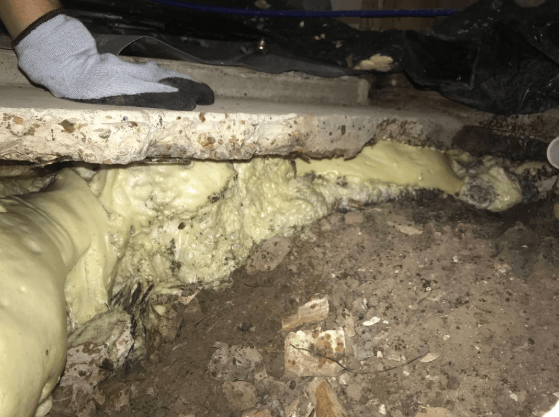
Concrete leveling is designed to restore existing slabs that remain structurally sound. PolyTex uses polyurethane foam injection to stabilize the supporting soil while lifting settled concrete back toward its original position.
Concrete leveling is often ideal when:
- Settlement is causing uneven slabs
- Trip hazards have developed
- Water pools on the surface
- Minor cracking has occurred
- Soil erosion created voids beneath the slab
- The concrete itself remains structurally intact
Because the slab stays in place, the repair focuses on solving the actual cause of the problem.
When Replacement Makes Sense
Concrete replacement still has an important role. Some slabs have reached the point where repair is no longer practical or structurally viable.
Replacement may be appropriate when:
- Concrete is severely deteriorated
- Large sections have broken apart
- Reinforcement has failed
- Significant structural damage exists
- The slab was improperly designed for its intended use
- New layout or expansion is required
In these situations, replacement provides a fresh starting point. However, even new concrete requires stable soil beneath it so soil stabilization solutions may still be required.
If the underlying conditions remain unchanged, settlement may eventually return.
Comparing the Two Options
Choosing between leveling and replacement involves more than comparing price. Property owners should evaluate several factors.
Time
Concrete replacement often requires:
- Demolition
- Hauling debris
- Site preparation
- New forms
- Pouring concrete
- Cure time before use
Depending on the project, this process may take several days or even weeks whereas Polyurethane concrete leveling is significantly faster. With poly leveling, many projects are completed in just a few hours, and the repaired surface is often ready for use shortly afterward.
Cost
Every project is different, but leveling frequently costs substantially less than full replacement because:
- Existing concrete remains in place.
- Demolition is eliminated.
- Disposal costs are reduced.
- Less labor is required.
- Construction time is shorter.
For many homeowners and commercial property owners, this represents significant savings.
Disruption
Replacement can interrupt daily life or business operations, especially since driveways often become inaccessible and parking lots may close during business hours. If the concrete is replaced in a commercial warehouse, the business may lose operating space and thus potential revenue and inconvenience. Concrete leveling minimizes these disruptions because the existing slab remains in place throughout the repair.
Environmental Impact
Concrete production requires significant energy and natural resources. When structurally sound concrete can be preserved, fewer materials are sent to landfills and fewer new materials must be produced. Repairing existing concrete is often the more sustainable solution and leaves a smaller footprint on our environment.
Why Houston Properties Experience Settlement So Frequently
Houston’s expansive clay soil creates unique challenges. As moisture levels change, clay expands and contracts repeatedly. Heavy rainfall introduces additional water into the soil. But this isn’t the only challenge. Dry periods remove moisture. Stormwater follows underground pathways.
These cycles continually reshape the soil supporting concrete. Even well-built slabs eventually experience movement under these conditions. That’s why understanding local soil behavior is so important when choosing a repair strategy.
Commercial Properties Face Additional Challenges
For commercial property owners, replacing concrete often involves much more than construction costs.
It may also mean:
- Business interruptions
- Lost customer access
- Delivery delays
- ADA accessibility concerns
- Increased liability
- Equipment downtime
Polyurethane concrete leveling allows many businesses to continue operating while repairs are completed.
This makes it an attractive option for:
- Warehouses
- Retail centers
- Apartment communities
- Manufacturing facilities
- Storage complexes
- Churches
- Schools
- Office buildings
How Polyurethane Foam Solves the Real Problem
Unlike replacement, polyurethane injection addresses what is happening beneath the slab.
During the repair process:
- Existing voids are identified.
- Expanding foam fills empty spaces.
- Loose soils become stabilized.
- The slab is carefully lifted.
- Support is restored.
Because the foam is lightweight and moisture resistant, it performs well in Southeast Texas soil conditions. Rather than simply installing new concrete over unstable ground, the repair improves the supporting foundation itself.
Questions to Ask Before Choosing Replacement
Before replacing settled concrete, consider these questions:
- Is the concrete structurally sound?
- What caused the settlement?
- Has the supporting soil been evaluated?
- Will replacement address the underlying problem?
- Can stabilization preserve the existing slab?
- What will replacement cost compared to leveling?
- How much downtime will replacement create?
These questions often reveal that repairing the underlying soil provides greater long-term value.
Why an Inspection Matters
Every property is different (obviously), and some projects genuinely require replacement. However, others can be restored quickly through stabilization and concrete leveling.
A professional inspection helps determine:
- Whether voids exist beneath the slab
- The condition of the existing concrete
- The cause of settlement
- Appropriate repair options
- Long-term stabilization needs
Making this decision based on facts rather than assumptions leads to better outcomes.
Final Thoughts
Settled concrete does not automatically mean replacement. In many cases, the concrete itself remains in excellent condition while the supporting soil has simply lost its ability to carry the load. By identifying the underlying cause of settlement and restoring support beneath the slab, polyurethane concrete leveling offers homeowners and commercial property owners a faster, less disruptive, and often more cost-effective alternative.
PolyTex Concrete specializes in helping property owners throughout Houston, Galveston, Conroe, The Woodlands, and surrounding Gulf Coast communities determine the right solution for their unique situation. Whether your project involves a residential driveway, a commercial warehouse floor, a parking lot, or municipal infrastructure, understanding why the concrete settled is the first step toward choosing the right repair.
If your concrete has begun sinking, cracking, or becoming uneven, schedule a free evaluation with PolyTex Concrete. Their team can determine whether leveling, stabilization, or replacement is the best long-term solution for protecting your investment. Contact PolyTex Concrete today.