
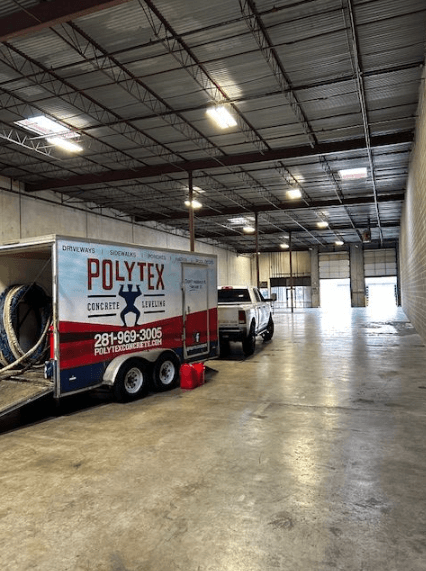
In a warehouse or distribution facility, a concrete floor with settlement can be a major concern. A warehouse floor is more than a walking surface. It is part of the operational infrastructure. Forklifts travel across it. Pallet jacks depend on it. Racking systems may rely on consistent elevations. Products, machinery, inventory, and employees all interact with the slab every day. When a warehouse floor begins to settle, even relatively small elevation changes can create problems far beyond the appearance of the concrete.
Uneven floors can affect material handling equipment, create trip hazards, contribute to drainage problems, and interfere with normal operations. In severe cases, settlement can become a significant maintenance concern that facility managers cannot afford to ignore.
Throughout Houston, Galveston, Conroe, The Woodlands, Montgomery and Southeast Texas, warehouse floor settlement is often caused by conditions beneath the concrete rather than failure of the slab itself. Understanding what is happening underground can help facility managers address settlement before it becomes a larger operational problem.
Why Warehouse Floors Settle
Concrete performs best when it has consistent support beneath it. A warehouse slab may appear massive and permanent, but it still depends on the soil and base material underneath it to distribute loads properly. When that support changes, the concrete can move. Several conditions can contribute to commercial slab settlement.
Poorly Compacted Fill
Commercial buildings frequently require significant site preparation before construction. Fill material may be placed to establish the correct building elevation. Utility trenches may also be excavated and backfilled before the floor is poured.
If any of this material is inadequately compacted, it can continue consolidating after construction. The warehouse may perform normally for years before the effects become noticeable. Eventually, the slab above the settling area begins to follow the movement below.
Water Migration Beneath the Building
Water does not need to be visible inside a warehouse to cause problems beneath it. Stormwater can migrate beneath buildings through surrounding soils, utility trenches, failed drainage systems, or areas of poor grading. As water moves, it can carry fine soil particles with it. Over time, this process may create weakened areas or hidden voids beneath the slab. Once the concrete loses consistent support, settlement can begin.
Plumbing and Utility Leaks
Commercial buildings may contain extensive underground plumbing and utility systems. A slow leak beneath a warehouse floor can remain undetected for a considerable amount of time. While the leak continues, surrounding soil can become saturated or begin eroding. The first visible evidence may not be water at all. It may be a section of concrete that has started to move.
Houston’s Changing Soil Conditions
Southeast Texas adds another variable: moisture-sensitive soil. Expansive clay soils found throughout the Houston region can change volume as moisture levels fluctuate. Wet conditions can cause clay to expand, while prolonged dry conditions allow it to contract. Large commercial slabs do not always respond uniformly to this movement. One portion of the building may remain stable while another loses support, creating differential settlement across the floor.
Why Small Elevation Changes Matter in a Warehouse
A quarter-inch change in a residential patio may go unnoticed. Inside an active warehouse, small elevation differences can have a much greater impact. Facility managers should consider how many systems depend on a relatively flat and predictable floor.
These may include:
- Forklifts
- Pallet jacks
- Automated material handling equipment
- Racking systems
- Conveyors
- Production equipment
- Mobile work platforms
- Employee walkways
When the slab moves, those systems may be affected. That is why warehouse concrete settlement should be viewed as an operational issue, not merely a cosmetic concrete problem.
Forklifts and Material Handling Equipment
Forklifts repeatedly travel the same routes throughout many warehouses. Uneven joints, depressions, and settled sections can create repeated impacts as equipment moves across them.
Over time, poor floor conditions may contribute to:
- Rougher equipment travel
- Additional vibration
- Increased operator discomfort
- Product movement on loads
- Additional wear on wheels and equipment components
In high-volume facilities, even minor inefficiencies become significant when they are repeated hundreds or thousands of times. Restoring a more consistent floor elevation can improve how equipment moves throughout the facility.
Racking and Equipment Deserve Special Attention
Settlement near pallet racking, machinery, or other structural systems should always be taken seriously. A settling slab does not automatically mean a rack or piece of equipment is unsafe. However, visible movement near these systems deserves professional evaluation.
Facility managers should avoid assuming that simply lifting the surrounding floor resolves every structural concern. The appropriate engineer, equipment specialist, or other qualified professional may need to evaluate systems affected by significant movement. PolyTex’s role is to identify and address the soil and concrete support conditions within the scope of the repair. That distinction matters, particularly in complex commercial environments.
Warning Signs of Warehouse Floor Settlement
Settlement does not always begin with a dramatic crack. Facility teams should watch for patterns that suggest the slab is moving.
Common warning signs include:
- Uneven slab joints
- Depressions in traffic lanes
- New or widening cracks
- Gaps beneath equipment bases
- Doors that no longer align properly
- Water collecting in previously dry areas
- Forklift operators reporting new bumps or uneven travel
- Separation between slabs and adjacent structures
- Hollow-sounding areas of concrete
One symptom alone does not necessarily confirm a major problem. Multiple symptoms concentrated in the same area, however, may indicate changing conditions beneath the slab.
The Hidden Problem May Be a Void
A warehouse floor can sometimes remain intact even after soil has disappeared beneath it. Concrete has enough strength to temporarily bridge across unsupported areas. From above, everything may appear relatively normal. Below the surface, a void may be developing. As forklifts, inventory, machinery, and the slab’s own weight continue loading the area, the unsupported concrete becomes increasingly vulnerable to movement. Eventually, the slab may settle into the empty space. This is one reason early evaluation can be valuable. The goal is to identify lost support before settlement becomes more extensive.
Why Tearing Out the Floor Isn’t Always the First Answer
Traditional concrete replacement inside an operating warehouse can be extremely disruptive.
The process may require:
- Removing inventory
- Relocating equipment
- Restricting forklift traffic
- Demolishing existing concrete
- Removing debris
- Preparing the subgrade
- Pouring new concrete
- Waiting for the replacement slab to reach the required strength
For an active commercial operation, the construction cost may only be part of the expense. Downtime matters too. If the existing slab remains structurally suitable for leveling, stabilizing the soil beneath it may offer a significantly less disruptive option.
How Polyurethane Injection Works Beneath a Warehouse Floor
Polyurethane injection allows PolyTex to address hidden voids and unstable soils through relatively small access points in the existing slab. The exact repair plan depends on the facility and site conditions, but the process generally involves evaluating settlement, determining appropriate injection locations, and introducing structural polyurethane beneath the concrete.
As the material reacts and expands, it can:
- Fill underground voids
- Restore contact beneath unsupported areas
- Help densify loose surrounding soils
- Provide lightweight structural support
- Carefully lift settled sections when appropriate
The objective is not simply to make the floor look level. It is to restore support beneath the slab.
Why Polyurethane Is Valuable in Commercial Environments
One of polyurethane injection’s biggest advantages is the ability to perform targeted repairs without demolishing large sections of existing concrete. That can be particularly valuable in warehouses where operations cannot simply stop for an extended construction project. Depending on project conditions, work may be staged around operational requirements, allowing facility managers to limit the area affected at one time.
Polyurethane also cures rapidly compared with traditional replacement processes, helping reduce the amount of time repaired areas must remain unavailable. For a busy facility, minimizing downtime can be just as important as the physical repair.
Soil Stabilization Is Different From Simply Lifting the Floor
This distinction is critical. If a warehouse floor settled because supporting soil was lost, raising the concrete without restoring that support would fail to address the underlying problem.
PolyTex approaches these projects from the bottom up.
What happened beneath the slab?
Where did support disappear?
Is water contributing to the problem?
Are voids present?
Is loose soil continuing to consolidate?
Understanding those questions allows the repair strategy to focus on stabilization rather than appearance alone.
Drainage and Water Problems Still Need Attention
Polyurethane can restore support where soil loss has occurred, but facility managers should also investigate why that soil loss happened. If stormwater continues entering beneath the building, a successful stabilization project does not eliminate the source of the water. The same applies to plumbing leaks, damaged drainage systems, or poor exterior grading. Long-term performance is strongest when the cause of soil movement is addressed along with the resulting settlement. This may require coordination between PolyTex, facility maintenance personnel, plumbers, drainage contractors, engineers, or other specialists depending on the situation.
The Cost of Waiting Can Extend Beyond Concrete
Commercial concrete settlement rarely becomes less expensive as it progresses.
Continued movement can increase:
- Repair scope
- Operational disruption
- Safety concerns
- Equipment impacts
- Maintenance requirements
- Areas requiring stabilization
For facility managers, early investigation provides options. Waiting until a slab has experienced extensive movement may reduce those options. A relatively small area of settlement today may be much easier to address than a larger affected section after another season of heavy rainfall or continued soil loss.
Warehouse Owners Should Think Below the Slab
When a warehouse floor becomes uneven, the natural reaction is to focus on the concrete. But the concrete may only be showing you what is happening underground.
The more important questions are often:
Why did this area move?
What changed beneath the floor?
Is water involved?
Has soil been lost?
Are there voids?
Could nearby areas be experiencing the same conditions?
Those questions lead to a better repair strategy than simply treating the visible crack or low spot.
Final Thoughts
Warehouse floor settlement can affect much more than the appearance of a commercial building. Uneven concrete can influence material handling, equipment movement, employee safety, drainage, and day-to-day operations. In many cases, however, the concrete slab itself is not the original source of the problem.
The supporting soil beneath it has changed. PolyTex Concrete provides polyurethane injection and soil stabilization solutions for commercial properties throughout Houston, Galveston, Conroe, The Woodlands, and surrounding Southeast Texas communities. By identifying hidden voids, restoring lost support, and carefully leveling suitable slabs, PolyTex can help facility managers address settlement while minimizing disruption to active operations.
If your warehouse floor is developing cracks, depressions, uneven joints, or other signs of settlement, schedule a free evaluation with PolyTex Concrete. Finding out what is happening beneath the slab today can help prevent a much larger operational problem tomorrow.