
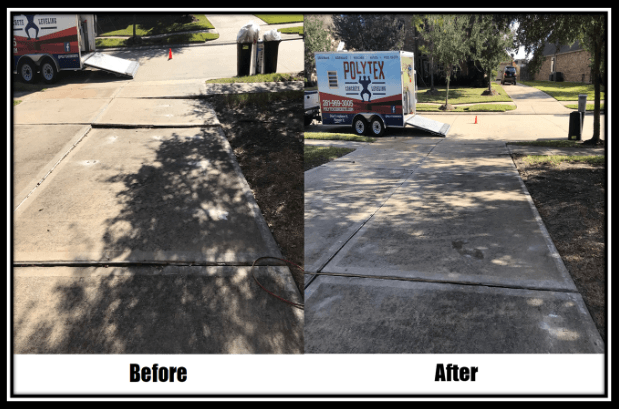
Most concrete problems don’t begin with a crack, they begin underground. Long before a driveway starts sinking or a warehouse floor settles, something is happening beneath the slab. Water is moving through the soil, fine particles are being carried away, and small empty spaces begin to form where solid ground once existed.
These empty spaces, known as voids, are one of the most common causes of concrete settlement throughout Houston, Galveston, Conroe, The Woodlands, and the surrounding Gulf Coast. The challenge is that you can’t usually see them until they’ve already become large enough to affect the concrete above. By the time a slab visibly sinks, the void underneath may have existed for months or even years. Understanding the warning signs allows property owners to address the problem early, often avoiding larger repairs and preserving the concrete they already have.
What Is a Void?
A void is exactly what it sounds like: an empty space beneath a concrete slab where supporting soil has been lost. Concrete is incredibly strong when it is evenly supported. Remove that support, however, and even the strongest slab begins to flex under its own weight.
Voids most commonly develop because:
- Stormwater washes soil away.
- Drainage problems repeatedly saturate the same area.
- Expansive clay soils shrink during dry weather.
- Poorly compacted fill settles over time.
- Water follows utility trenches beneath slabs.
- Culverts and drainage structures allow soil migration.
The concrete doesn’t suddenly become weak, the ground simply disappears beneath it.
Why You Usually Don’t Notice a Void Right Away
One of the reasons voids become expensive problems is that they develop silently.
At first, the slab bridges over the empty space much like a bridge spans a river. The concrete may continue supporting vehicles, patio furniture, warehouse traffic, or pedestrians with no obvious signs of trouble. Meanwhile, every heavy rain, every moisture cycle, and every passing day allows the void to grow. Eventually, the unsupported section becomes too large.
That’s when homeowners suddenly notice:
- A driveway corner has dropped.
- A sidewalk has become uneven.
- Water begins collecting where it never used to.
- A crack suddenly appears after a storm.
The settlement feels sudden…the void wasn’t.
Sign #1: Water Pools Where It Never Used To
Standing water is often the earliest visible clue. Concrete is designed to shed water away from structures. When one section begins settling even slightly, water naturally finds the new low spot.Many homeowners assume the puddle caused the problem. More often, the puddle is evidence that settlement has already begun. If you notice water collecting in the same location after every rainfall, the supporting soil beneath that section may already be changing.
Sign #2: Cracks That Continue Growing
Not every concrete crack indicates a structural problem. Hairline shrinkage cracks are common. The concern is when cracks continue changing.
Watch for:
- Cracks becoming wider.
- One side sitting higher than the other.
- Multiple cracks radiating from one area.
- New cracks appearing after heavy rain.
These often indicate movement beneath the slab rather than simple surface aging.
Sign #3: Hollow Sounds Beneath the Concrete
One of the simplest ways professionals identify potential voids is by listening. When sections of concrete lose support, they sometimes produce a hollow sound when tapped or walked across. The slab is no longer resting firmly on compacted soil. Instead, it is bridging over an empty space. While this isn’t always noticeable to homeowners, unusually hollow-sounding concrete deserves professional evaluation.
Sign #4: Soil Washing Out Along the Edges
If soil is disappearing from the sides of your driveway, sidewalk, patio, or culvert, it is often disappearing beneath the slab as well.
Look for:
- Small gaps along slab edges.
- Exposed aggregate beneath concrete.
- Washed-out mulch or landscaping.
- Depressions forming next to concrete.
- Soil collecting farther downhill after storms.
These are all indicators that water is actively transporting soil.
Where soil leaves, voids often follow.
Sign #5: Uneven Concrete That Seems to Get Worse
Settlement is rarely a one-time event. Once the supporting soil begins failing, each rainfall and moisture cycle tends to enlarge the problem. What starts as a quarter-inch height difference can gradually become an inch or more. The longer the void remains unfilled, the larger the unsupported area becomes. This is why early intervention is so important.
Residential and Commercial Properties Experience the Same Problem
Voids don’t discriminate.
Homeowners often see them beneath:
- Driveways
- Sidewalks
- Pool decks
- Patios
- Garage floors
Commercial property owners encounter them beneath:
- Warehouse slabs
- Loading docks
- Parking lots
- Retail sidewalks
- Storage facilities
- Industrial floors
Municipalities frequently find them around:
- Culvert pipes
- Roadways
- Bridge approaches
- Stormwater infrastructure
- Manholes
The cause may differ slightly, but the underlying issue remains the same: lost soil equals lost support.
How PolyTex Detects Hidden Voids
Not every void can be identified visually. During an evaluation, PolyTex looks for patterns of settlement, drainage issues, soil movement, and structural clues that indicate underground erosion. By understanding how water behaves beneath the surface, technicians can often identify the problem before significant structural damage occurs. The goal isn’t simply to lift concrete, it’s to restore the support beneath it.
How Poly Injection Restores Support
Polyurethane foam injection addresses both the symptom and the underlying cause.
After locating the affected area:
- Small access holes are drilled through the slab.
- Expanding polyurethane foam is injected beneath the concrete.
- The foam fills empty spaces.
- Loose soils are compacted.
- The slab is gently lifted where appropriate.
- Long-term support is restored.
Because the foam is lightweight and resistant to moisture, it provides durable stabilization without adding unnecessary weight to already unstable soils.
Why Early Detection Saves Thousands
Waiting until a slab has significantly settled often means:
- Larger voids
- More extensive repairs
- Additional cracking
- Increased liability
- More disruption
Identifying and stabilizing voids while they are still relatively small can preserve existing concrete and significantly reduce repair costs. For both homeowners and commercial property managers, early action almost always produces better long-term outcomes.
Final Thoughts
Hidden voids are one of the leading causes of concrete settlement throughout Southeast Texas. Although the damage usually begins underground, the warning signs often appear long before complete failure occurs. Understanding what to watch for allows property owners to act before a small problem becomes a major repair.
PolyTex Concrete specializes in identifying hidden voids, stabilizing weakened soil, and restoring support beneath existing concrete through advanced polyurethane injection technology. Whether the issue involves a residential driveway, commercial warehouse, municipal roadway, or waterfront structure, correcting the problem below the surface helps protect everything above it.
If you’ve noticed standing water, growing cracks, uneven concrete, or signs of soil washout, now is the ideal time to schedule a professional evaluation before hidden voids continue to expand.