
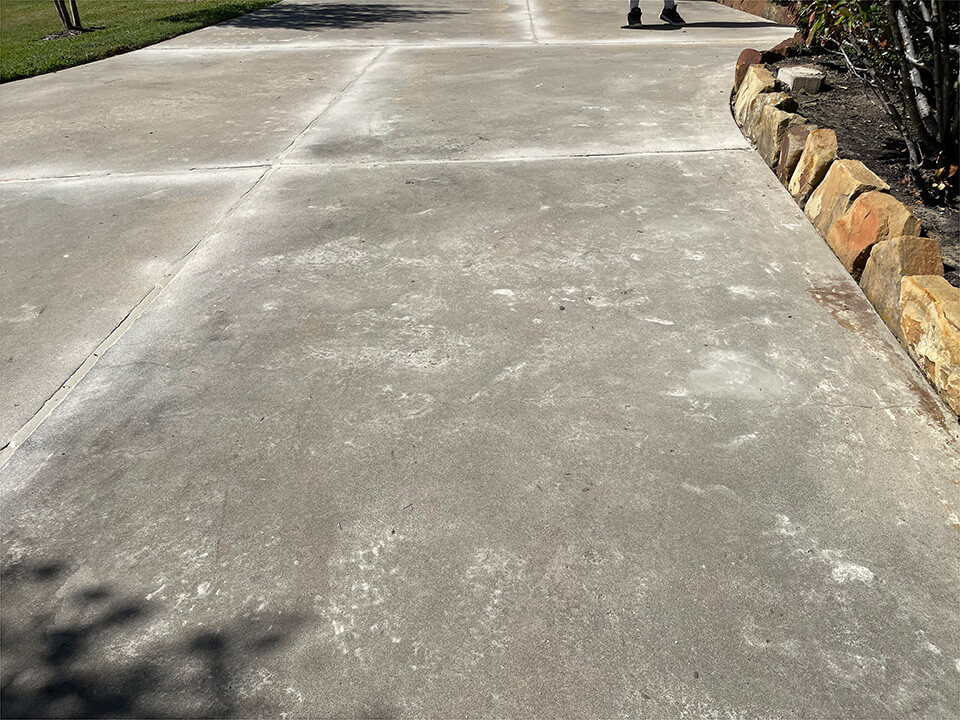
When it comes to leveling a sinking residential driveway, most homeowners do not think much about their driveway until something changes such as a crack appearing or it starts to sink. Water starts pooling in one area due to one section settling lower than the rest. Suddenly, what was once a smooth surface becomes an eyesore and a potential safety concern.
Across Houston, Galveston, Conroe, and surrounding communities, driveway settlement is one of the most common issues homeowners face. While many assume the concrete itself has failed, the real problem is usually hidden beneath the surface. In most cases, the soil supporting the driveway has shifted, eroded, or lost its ability to properly support the slab. Understanding why this happens and how it can be repaired can help homeowners avoid more expensive problems in the future.
Why Driveways Begin to Settle
Concrete is incredibly strong, but it is only as stable as the soil beneath it. When that soil moves, the concrete moves with it and creates issues with slabs and infrastructure.
Several factors contribute to driveway settlement throughout Southeast Texas. Heavy rainfall is one of the biggest culprits as water can wash away supporting soil beneath the slab, creating voids that eventually lead to sinking concrete. As residents of the region, PolyTex experts know that expansive clay soil is common issue in Houston. During wet periods, the soil expands, but during dry periods, it contracts. This constant movement creates instability beneath driveways and sidewalks.
Poor compaction during construction can also contribute to settlement. If the soil was not properly compacted before the driveway was poured, the ground may continue settling for years afterward. Tree roots, drainage issues, and aging infrastructure can all contribute to the problem as well.
Common Signs of Driveway Settlement
Settlement often begins gradually. Similar to slowing turning up the heat when boiling a lobster, many homeowners only notice small changes before realizing the issue is becoming more serious.
Some of the most common warning signs include:
- Cracks developing across the driveway
- Uneven sections between slabs
- Water pooling in low areas
- Gaps forming along garage floors
- Sidewalks settling near the driveway
- Trip hazards where slabs no longer align
These symptoms indicate that support beneath the concrete may be compromised.
Why Small Problems Become Bigger Problems
One of the biggest mistakes homeowners make is assuming that minor settlement is only cosmetic, but the reality is that concrete problems tend to worsen over time and scale quickly. As water continues moving beneath the slab, voids grow larger. The unsupported concrete becomes more vulnerable to cracking and movement. Drainage issues become worse, which often accelerates erosion beneath the driveway. Eventually, what started as a small settlement issue can lead to significant repairs and addressing the problem early is almost always less expensive than waiting.
The Impact on Curb Appeal (When Appearances Matter)
Your driveway is one of the first things people see when they arrive at your home and acts as a welcome mat for visitors.
An uneven or cracked driveway can negatively affect the cosmetics of your property such as:
- Overall curb appeal
- Property value
- First impressions
- Home resale potential
While appearance may not be the most important concern, it is certainly a factor homeowners should consider. A properly leveled driveway improves both functionality and aesthetics.
Safety Concerns Homeowners Should Not Ignore
Beyond appearance, uneven concrete creates legitimate safety hazards to anyone visiting the property. Raised slab edges and settled sections increase the risk of trips and falls and can be especially concerning for:
- Children
- Elderly family members
- Guests
- Delivery personnel
The last thing any homeowner wants is an injury caused by a preventable concrete issue. Level surfaces help eliminate these risks and create a safer environment around the home.
Why Concrete Replacement Is Not Always Necessary
Many homeowners assume that a sunken driveway must be torn out and replaced, but fortunately, that is often not the case. In many situations, the concrete itself remains structurally sound and problem is simply a lack of support beneath the slab. Rather than replacing perfectly usable concrete, PolyTex focuses on restoring support below the surface. This approach often saves homeowners significant time, money, and disruption.
How PolyTex Levels Residential Driveways
PolyTex Concrete uses advanced polyurethane foam injection to stabilize soil and lift settled concrete. The process begins with a detailed evaluation of the affected area. Technicians identify settlement patterns, locate voids, and determine the cause of the movement. Small access holes are then drilled into the slab. Through these openings, specialized polyurethane foam is injected beneath the concrete.
As the injected poly foam expands, it fills voids, compacts loose soil, and gently raises the slab back toward its proper position. Once cured, the foam creates a stable support system beneath the driveway. You may not believe it (especially if you’ve had replacement quotes), but most projects can be completed quickly with minimal disruption to the property.
Benefits of Poly Injection for Homeowners
Homeowners appreciate polyurethane foam leveling because it offers several advantages over traditional replacement.
Benefits include:
- Faster project completion
- Minimal disruption to landscaping
- Smaller drill holes
- Immediate usability in many cases
- Long-term soil stabilization
- Reduced overall cost compared to replacement
Because the process addresses the underlying soil issue, it provides a more complete solution.
Houston and Galveston Soil Conditions Create Unique Challenges
Southeast Texas presents conditions that make soil stabilization particularly important. In Houston, expansive clay soils create constant movement beneath concrete surfaces. Even small moisture changes can cause noticeable shifts.
In Galveston, sandy soils are more susceptible to erosion and water infiltration. Coastal weather patterns can accelerate soil loss beneath driveways and walkways.
PolyTex understands these local conditions and tailors repairs accordingly.
Their experience working throughout the region allows them to provide solutions specifically designed for Gulf Coast environments.
Why Early Action Matters
The longer settlement continues, the more difficult the repair can become.
Early intervention helps:
- Prevent additional cracking
- Reduce soil erosion
- Improve drainage
- Maintain property value
- Avoid larger repair costs
Many homeowners are surprised to learn how much easier the repair process can be when problems are addressed early.
A Few Final Thoughts
A sinking driveway is often a sign of a much larger issue occurring beneath the surface. While cracks and uneven slabs are easy to see, the real problem is usually unstable soil and void formation below the concrete. PolyTex Concrete helps homeowners throughout Houston, Galveston, Conroe, and surrounding communities restore stability through professional concrete leveling and soil stabilization solutions. By addressing the root cause of settlement, they help protect your home, improve safety, and extend the life of your concrete.
If your driveway is beginning to crack, settle, or collect standing water, now is the perfect time to schedule a free evaluation and learn how PolyTex can help restore your concrete before the problem grows larger.