
When most people hear the term polyurethane foam injection, they picture something similar to the spray foam insulation used in homes. While both materials expand, that’s where the similarities end.
The polyurethane used for concrete leveling and soil stabilization is an engineered structural material designed to restore support beneath concrete slabs, fill underground voids, and stabilize weakened soil. It has transformed the way engineers, municipalities, commercial property owners, and homeowners approach concrete repair because it solves the underlying problem instead of simply covering the symptoms.
Across Houston, Galveston, Conroe, The Woodlands, and the surrounding Gulf Coast, polyurethane injection has become one of the preferred methods for repairing settled concrete because it is fast, minimally invasive, and designed for long-term performance. Understanding how the technology works helps explain why so many property owners choose stabilization over demolition and replacement.
Concrete Rarely Fails on Its Own
If we’ve said it once, we’ll say it again. One of the biggest misconceptions in the concrete industry is that concrete becomes unlevel or settled because the concrete itself has failed. In reality, the opposite is usually true. Concrete is incredibly strong in compression and is capable of lasting decades when properly supported. The reality is that the issue lies below the concrete slab.
Over time, several factors weaken the supporting soil:
- Heavy rainfall
- Stormwater runoff
- Underground erosion
- Expansive clay movement
- Poor compaction
- Utility trench settlement
- Water migration
As soil moves or washes away, also known as soil erosion, voids begin forming beneath the slab. Without uniform support, concrete settles under its own weight and causes significant safety and structural issues. Polyurethane foam is designed to restore that missing support and stabilize the soils beneath the concrete.
What Is Structural Polyurethane Foam?
Structural polyurethane foam is a two-component polymer that expands after being injected beneath concrete. When the materials combine, a controlled chemical reaction takes place and creates expanding foam capable of filling irregular underground spaces. Unlike traditional fill materials, the foam seeks out voids that would be nearly impossible to reach through excavation.
As it expands, it:
- Fills empty spaces
- Compacts loose soil
- Restores support beneath the slab
- Lifts settled concrete when needed
- Helps reduce future movement
Once cured, the material becomes rigid enough to support significant structural loads while remaining lightweight compared to traditional fill materials such as mudjacking.
How Polyurethane Foam Lifts Concrete
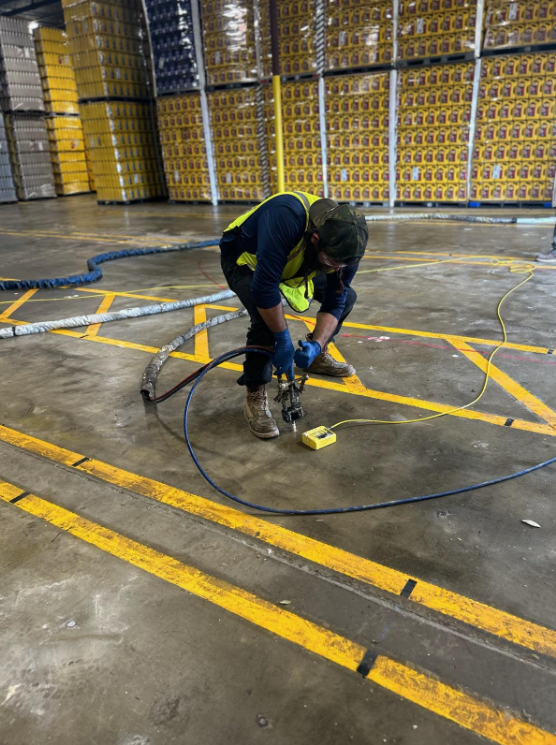
Many people imagine crews pushing concrete upward, but that isn’t really how the PolyTex Concrete leveling process works. After carefully evaluating the area, technicians drill small access holes through the concrete. The polyurethane foam is then injected beneath the slab through the small holes. As the foam expands, it follows the path of least resistance, filling empty spaces first. Only after those voids have been filled does controlled lifting begin.
Because the expansion can be carefully monitored, technicians are able to make precise adjustments while continuously checking slab elevation. This allows concrete to be raised gradually rather than forced upward all at once. This gives the PolyTex Concrete crew precision control, which is one of the reasons polyurethane foam has become such a valuable repair method.
Why Lightweight Material Matters
One advantage that surprises many property owners is how light polyurethane foam actually is. Traditional repair methods often rely on cement-based materials.
While effective in certain situations, those materials add considerable weight beneath already unstable soils. Polyurethane foam provides structural support without placing unnecessary stress on weak subgrades. This makes it particularly valuable in Southeast Texas, where expansive clay and moisture-sensitive soils are common. Rather than adding another heavy layer, the repair strengthens the existing support system while remaining lightweight and eco-friendly.
How Foam Finds Hidden Voids
One reason polyurethane performs so well is its ability to flow into spaces that cannot be seen from the surface. Underground voids are rarely uniform and may be only a few inches deep, whereas others may extend beneath large portions of a slab and run extensively throughout the property.
As the material expands, it naturally follows interconnected spaces beneath the concrete. Instead of simply filling one hole, it can restore support across an entire weakened area.
This ability makes polyurethane especially effective beneath:
- Driveways
- Sidewalks
- Pool decks
- Garage floors
- Warehouse slabs
- Parking lots
- Culvert crossings
- Bulkheads
- Municipal infrastructure
How Polyurethane Helps Stabilize Soil
You might think polyurethane only lifts concrete, but in reality, soil stabilization is one of its greatest strengths. As expanding foam enters loose soil, it compresses surrounding material while filling empty spaces created by erosion. This process increases the density of the supporting soils and reduces the likelihood of additional settlement. Rather than simply raising the slab, the repair improves what is happening beneath it. Lifting concrete without stabilizing the soil often means the underlying problem remains.
PolyTex Concrete focuses on solving both and save customers time and money on potential future repairs.
Why Polyurethane Performs Well in Houston
Houston presents unique challenges because of expansive clay soil. As moisture changes throughout the year, clay continually expands and contracts. These cycles create movement beneath slabs long before visible damage appears.
Polyurethane foam is well suited for these conditions because it:
- Is lightweight
- Resists moisture
- Fills irregular voids
- Restores uniform support
- Helps stabilize weakened soils
For many projects, this creates a more durable long-term solution than simply replacing concrete.
Commercial Applications
Polyurethane injection is widely used beyond residential properties. In-fact, commercial projects have become a large portion of PolyTex Concrete’s business as these properties suffer from the same issues as residential properties, but often on a larger scale.
Commercial applications include:
- Warehouse floor stabilization
- Loading dock repair
- Retail sidewalks
- Parking lots
- Manufacturing facilities
- Distribution centers
- Airport pavements
- Schools
- Hospitals
- Municipal infrastructure
Because repairs can often be completed with minimal disruption, many businesses are able to continue operating during the project. This reduces downtime and is one of the reasons commercial property owners increasingly choose polyurethane stabilization.
Infrastructure and Municipal Uses
Engineers and municipalities also rely on polyurethane injection for infrastructure repairs.
Common applications include:
- Culvert stabilization
- Bridge approach settlement
- Roadway void filling
- Stormwater structures
- Manholes
- Utility corridors
- Seawalls
- Bulkheads
Rather than excavating large sections of roadway or infrastructure, polyurethane allows targeted repairs that restore support beneath existing structures.
Is Polyurethane Durable?
One of the most common questions property owners ask is whether polyurethane lasts. Modern structural polyurethane is designed for long-term performance beneath concrete. When properly installed and combined with appropriate drainage management, it provides durable support that resists moisture and maintains its structural properties over time. Like any repair, long-term success also depends on addressing the conditions that caused the settlement. If drainage issues continue unchecked, new erosion can eventually develop elsewhere on the property. This is why PolyTex evaluates the entire site instead of focusing only on the visible symptom.
Why Experience Matters
Polyurethane injection is both a science and an art. Every property responds differently.
Technicians must understand:
- Soil conditions
- Water movement
- Void formation
- Concrete behavior
- Expansion characteristics
- Elevation control
Successful repairs depend on proper evaluation just as much as the material itself.
That experience allows PolyTex to develop repair strategies tailored to each project rather than relying on one-size-fits-all solutions.
Final Thoughts
Polyurethane foam injection has changed the way concrete settlement is repaired throughout Houston and Southeast Texas. Instead of replacing structurally sound concrete, the technology restores support beneath the slab by filling voids, stabilizing weakened soils, and carefully lifting settled surfaces. For homeowners, businesses, engineers, and municipalities, the greatest advantage is that the repair addresses the cause of settlement rather than simply replacing the symptom.
PolyTex Concrete specializes in advanced polyurethane foam injection for residential, commercial, municipal, and waterfront applications throughout Houston, Galveston, Conroe, The Woodlands, and surrounding communities. If your property is experiencing uneven concrete, soil erosion, or underground voids, schedule a free evaluation to learn whether polyurethane stabilization is the right solution for your project.