
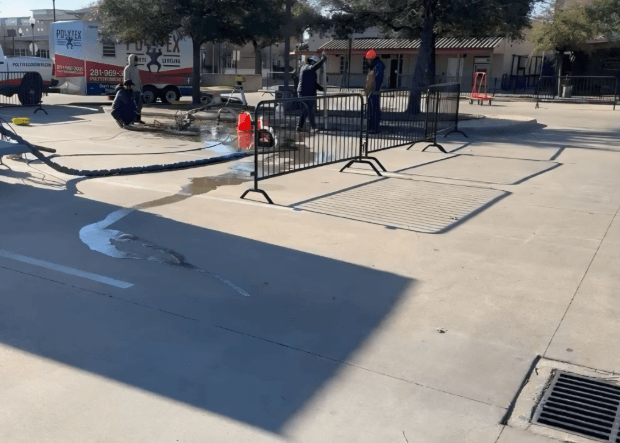
A commercial parking lot is one of the first things customers, tenants, employees, and visitors experience when they arrive at a property. When the concrete is level and properly draining, most people never think about it. But when sections begin to sink, cracks develop, or water starts collecting in low areas, the parking lot can quickly become a maintenance and safety concern.
For commercial property owners and facility managers, uneven concrete is about more than appearance. Settlement can interfere with drainage, create pedestrian trip hazards, make transitions between sidewalks and parking areas uneven, and contribute to continued deterioration if the underlying problem is allowed to progress.
Throughout Houston, Galveston, Conroe, The Woodlands, and Southeast Texas, parking lot settlement is often a sign of something happening beneath the concrete. Proceed with caution, the visible low spot may only be the symptom. The real problem may be lost soil, underground voids, changing moisture conditions, poor compaction, or stormwater erosion beneath the slab. Understanding the cause is the first step toward determining whether the concrete needs to be replaced or whether the existing slab can be stabilized and leveled.
Why Commercial Parking Lots Settle
Concrete requires consistent support. A parking lot may be engineered to handle vehicle traffic and substantial loads, but the slab still depends on the soil and base material beneath it. When that supporting material changes, the concrete above can move. Several conditions commonly contribute to parking lot settlement in Southeast Texas.
Stormwater Can Slowly Remove Supporting Soil
Parking lots collect enormous amounts of rainwater. Unlike landscaped areas where some rainfall can soak directly into the ground, large concrete surfaces concentrate runoff and direct it toward drains, curbs, ditches, retention areas, and other drainage systems. When those systems work correctly, water moves away from the property in a controlled manner. When they don’t, water may begin moving beneath the concrete.
A damaged joint, poorly sealed edge, drainage failure, or erosion channel can allow water to enter the supporting soils. Once water establishes a pathway beneath the slab, it can begin carrying away fine soil particles. The process may be slow at first, but storm after storm, more material can disappear. Eventually, a void forms beneath the parking lot.
The concrete above may temporarily bridge across that empty space, but once the unsupported area becomes large enough, the slab can begin settling.
Houston’s Heavy Rain Makes Drainage Especially Important
Commercial properties throughout the Houston and Gulf Coast region routinely experience periods of intense rainfall. That makes drainage one of the most important factors affecting long-term concrete performance.
Facility managers should watch for areas where:
- Water repeatedly collects after storms
- Runoff flows beneath slab edges
- Soil is washing away near curbs
- Drainage inlets appear overwhelmed
- Concrete has settled around drains
- Downspouts discharge near paved areas
- Landscaping directs water toward the parking lot
Standing water isn’t always the cause of settlement. Sometimes it is one of the first signs that settlement has already occurred. When a slab drops slightly, it creates a new low point. Water then collects in that area, which can allow even more moisture to reach the supporting soil. The result can become a repeating cycle of water intrusion, erosion, and additional settlement.
Poorly Compacted Fill Can Cause Problems Years Later
Not every parking lot problem is caused by erosion. Some settlement begins during construction. Commercial sites frequently require grading and fill material to establish the proper elevation before concrete is installed. Utility lines, stormwater pipes, electrical systems, and other infrastructure may also require trenches that are later backfilled.
If those areas are not uniformly compacted, the soil can continue consolidating after construction. A parking lot may perform well for years before visible settlement develops. This is why isolated low areas sometimes appear along utility corridors or near previously disturbed sections of a property. The concrete didn’t suddenly become defective. The supporting material beneath it continued moving.
Heavy Vehicle Traffic Can Expose Weak Areas
Commercial parking lots experience loading that residential driveways rarely encounter.
Depending on the property, traffic may include:
- Delivery trucks
- Box trucks
- Garbage trucks
- Emergency vehicles
- Moving trucks
- Construction vehicles
- Tractor-trailers
- Customer vehicles
A properly supported concrete slab is designed to distribute these loads. But when a void develops beneath the concrete, the slab no longer has uniform support. Repeated vehicle loads can expose those weakened areas and accelerate visible settlement or cracking. Again, the vehicle isn’t necessarily the original cause. It may simply reveal a support problem that already existed underground.
Why Uneven Parking Lots Become a Property Management Concern
Small elevation changes can have consequences beyond the slab itself. Property managers should pay particular attention to settlement around pedestrian areas.
These may include:
- Crosswalks
- Sidewalk transitions
- Store entrances
- Handicap-accessible routes
- Curb ramps
- Loading areas
- Dumpster enclosures
- Building entrances
An uneven transition that seems minor from inside a vehicle may be much more noticeable to someone walking across the property. Commercial property owners have an ongoing interest in maintaining safe, accessible walking surfaces and addressing known hazards appropriately.
Settlement Around Drainage Structures Deserves Attention
One area PolyTex can encounter on commercial properties is settlement near storm drains and other drainage structures. These areas deserve particular attention because water is intentionally concentrated there. If surrounding soils begin eroding or backfill settles, concrete adjacent to the structure may begin dropping.
Property managers may notice:
- Depressions around drains
- Cracking radiating from drainage structures
- Water collecting beside rather than entering the drain
- Gaps between concrete and drainage components
- Continued settlement after previous surface repairs
Repairing the visible crack alone does not restore missing soil beneath the slab. The support problem must be evaluated.
Hidden Voids Can Exist Before the Parking Lot Looks Damaged
One of the challenges with commercial concrete is that significant soil loss can occur without obvious surface damage. Concrete has enough strength to span smaller unsupported areas. That means a slab can look relatively normal even while a void is developing beneath it.
Eventually, however, the unsupported area may become too large. Settlement begins, cracks develop, or the slab responds differently under vehicle loads. This is why visible soil washout, unexplained depressions, recurring cracks, and changing drainage patterns should not automatically be dismissed as normal aging. They may be clues to a deeper problem.
Does Settled Concrete Have to Be Replaced?
Not necessarily. This is an important distinction for commercial property owners because replacing parking lot concrete can involve substantial disruption.
Traditional replacement may require:
- Closing parking spaces
- Restricting traffic
- Demolishing existing slabs
- Removing concrete debris
- Preparing the subgrade
- Pouring replacement concrete
- Allowing sufficient curing time
- Redirecting customers and deliveries
For some damaged slabs, replacement is absolutely the correct solution. But if the existing concrete remains structurally suitable and the primary issue is lost support beneath it, concrete leveling may provide a less disruptive alternative.
How Polyurethane Injection Restores Support
PolyTex Concrete uses structural polyurethane injection to address voids and settlement beneath suitable commercial concrete slabs. Small access points are created through the existing concrete, allowing polyurethane material to be injected beneath the surface. As the material reacts and expands, it can fill voids and restore contact between the slab and the supporting ground. When conditions allow, controlled injection can also raise settled concrete toward the desired elevation.
The process can accomplish several objectives:
- Fill underground voids
- Restore support beneath the slab
- Help stabilize loose soils
- Correct certain elevation differences
- Preserve existing concrete
- Reduce the need for extensive demolition
The objective is not simply to make the parking lot look better. It is to address the missing support that contributed to the movement.
Why Polyurethane Is Well Suited for Active Commercial Properties
Commercial repairs create a challenge residential projects often don’t. The business may need to remain open. Customers still need parking. Deliveries still need access. Employees still need to reach the building.
Polyurethane injection can often be performed in targeted areas, allowing property managers to limit the portion of the parking lot affected by the work. Because structural polyurethane reacts and cures rapidly, appropriate repaired areas can generally return to service much faster than areas requiring traditional removal and replacement. For commercial owners, that reduced disruption can be a major advantage.
Different Commercial Properties Face Different Risks
Parking lot settlement isn’t limited to one type of business.
PolyTex’s stabilization approach may be applicable to suitable concrete areas at:
- Shopping centers
- Grocery stores
- Restaurants
- Office complexes
- Apartment communities
- Hotels
- Churches
- Schools
- Medical facilities
- Self-storage facilities
- Warehouses
- Industrial properties
- Marinas
Each site has different traffic patterns, drainage conditions, soil characteristics, and operational needs.
That’s why the repair should begin with an evaluation rather than a predetermined solution.
Property Managers Should Watch for Changes, Not Just Damage
One of the best ways to identify settlement early is to notice changes.
Be sure to ask yourself a few simple questions:
Was that puddle there last year?
Has this crack become wider?
Did this sidewalk transition used to be level?
Is soil disappearing along the edge?
Are customers or employees mentioning an uneven area?
Has a previously repaired section started moving again?
Those observations can reveal developing problems before the concrete experiences significant damage. Photographing questionable areas periodically can also make gradual changes easier to recognize.
Why Surface Patching Often Isn’t Enough
A common response to cracking or uneven concrete is to patch the visible surface. That may improve appearance temporarily, but a patch cannot replace missing soil beneath a slab. If the concrete continues moving, the patch often cracks again. Repeated surface repairs can become a clue that the real issue exists below ground. Before continuing to patch the same area, it may be worth determining whether the slab has lost support.
Address the Water Along With the Concrete
Polyurethane stabilization can restore support where soil has been lost, but property owners should also investigate the source of that soil loss. If a broken drainage pipe continues releasing water beneath the parking lot, the drainage problem still needs to be repaired.
The same applies to:
- Poor grading
- Failed storm drains
- Broken irrigation systems
- Damaged gutters
- Erosion channels
- Persistent runoff
The strongest long-term strategy combines appropriate concrete stabilization with correction of the conditions contributing to the problem.
Early Evaluation Can Preserve More of the Existing Parking Lot
Concrete settlement tends to become more complicated as it progresses. A relatively small void may eventually become a larger unsupported area. A slight elevation difference may eventually become a trip hazard. A small drainage issue may eventually contribute to substantial soil loss. Early evaluation gives commercial property owners more options. In many situations, preserving an existing slab is easier when the underlying problem is addressed before extensive cracking or deterioration occurs.
Final Thoughts
A sinking commercial parking lot is rarely just a surface problem. The low spot, crack, or uneven slab may be telling you that something has changed beneath the concrete. Stormwater erosion, hidden voids, poorly compacted fill, utility trenches, and Southeast Texas soil conditions can all contribute to lost support and eventual settlement.
For commercial property owners and facility managers, identifying that problem early can help reduce disruption, preserve existing concrete, improve drainage, and maintain safer surfaces for customers, employees, tenants, and visitors. PolyTex Concrete provides commercial concrete leveling, void filling, and soil stabilization solutions throughout Houston, Galveston, Conroe, The Woodlands, and surrounding Southeast Texas communities.
If you’ve noticed sinking concrete, recurring cracks, standing water, or changing elevations in your commercial parking lot, schedule a free evaluation with PolyTex Concrete. Understanding what is happening beneath the pavement is the first step toward determining the right long-term solution.