
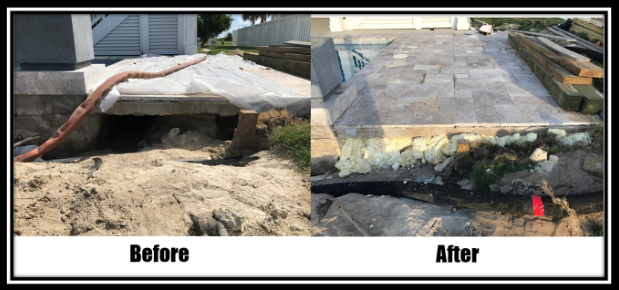
A concrete patio is supposed to feel like an extension of your home. Whether it supports an outdoor kitchen, patio furniture, a grill, or simply a place to relax, homeowners expect the surface to remain relatively level and drain water in the right direction. When a patio begins to sink, the first signs can seem minor. A little water collects near one corner after a storm. One slab sits slightly lower than another. A crack appears near the house. Patio furniture no longer sits quite as level as it used to. Over time, those small changes can become much harder to ignore.
Throughout Houston, Conroe, The Woodlands, Galveston, and surrounding Southeast Texas communities, sinking patios are often caused by changes in the soil beneath the concrete rather than failure of the slab itself. Heavy rainfall, expansive clay, poor drainage, underground erosion, and settling fill material can all reduce the support beneath an otherwise usable patio. Before tearing out the concrete, homeowners should understand why the patio moved and whether the existing slab can be stabilized and preserved.
Why Do Concrete Patios Sink?
Concrete is strong, but it cannot support itself indefinitely across empty space. Every patio depends on properly prepared soil and base material beneath the slab. If that support remains consistent, the patio can perform well for decades. If soil settles, shrinks, washes away, or develops underground voids, the concrete above begins responding to those changes.
One portion of the patio may remain properly supported while another begins settling. This creates differential movement, which can result in cracks, uneven surfaces, poor drainage, and gaps along the slab. The visible concrete problem is often only the symptom. The real change occurred underneath it.
Poorly Compacted Fill Can Cause Patio Settlement Years Later
Patios are commonly constructed near homes where the soil may have previously been disturbed during construction. Excavation for the foundation, utilities, plumbing, drainage, and other systems can leave areas that must later be backfilled. If that material is not uniformly compacted, it may continue consolidating long after the patio is poured. As the soil occupies less space, a gap can gradually develop beneath the concrete.
This type of settlement may happen slowly enough that homeowners barely notice it. The patio can perform normally for years before a low corner or growing crack becomes obvious. That delay can make the settlement seem sudden even though the supporting soil has been changing for a long time.
Water Around the House Can Accelerate the Problem
Houston homeowners are familiar with heavy rain, and patios can receive a tremendous amount of runoff during a storm. Water may come from the patio itself, the roof, gutters, downspouts, landscaping, or surrounding yard. Problems begin when that water consistently moves toward or beneath the concrete instead of away from it. Over time, flowing water can carry fine soil particles away from beneath the slab. Small underground spaces become larger voids, and the patio gradually loses support.
Homeowners should pay particular attention to downspouts that discharge near patios, areas where water flows along the edge of the concrete, soil washing away after storms, and low spots that remain wet long after surrounding areas have dried. Those conditions can provide valuable clues about what is happening below the surface.
Expansive Clay Creates Constant Movement
Southeast Texas soils add another challenge. Expansive clay changes volume as its moisture content changes. During wet periods, clay absorbs moisture and expands. During prolonged dry weather, it contracts. Those changes can occur repeatedly throughout the life of a home.
The soil beneath a patio does not always gain or lose moisture evenly. One side may sit beside irrigated landscaping while another receives direct sun. A covered section may remain relatively dry while an exposed section receives significant rainfall. These differences can create uneven support conditions beneath the same slab and contribute to settlement or movement over time.
Watch the Direction Your Patio Is Moving
Not all patio settlement has the same consequences. Where the slab is moving can be just as important as how much it has moved. A patio that settles away from the house may primarily create an uneven walking surface or cosmetic concern. A patio that settles toward the house deserves additional attention because it can change how surface water drains.
Concrete around a home should not create an easy pathway for stormwater to collect against the structure. If patio settlement has created a low area near the house, water may begin accumulating where it previously drained away. Correcting the concrete elevation may help restore drainage, but the entire water-management situation should be evaluated rather than assuming leveling alone solves every drainage issue.
Warning Signs Your Patio May Be Losing Support
Settlement tends to reveal itself gradually. Homeowners should watch for changes rather than waiting for severe damage.
Common warning signs include:
- One section sitting lower than another
- Water collecting in new locations
- Cracks that continue widening
- Gaps beneath exposed slab edges
- Soil washing away beside the patio
- Separation between the patio and adjacent concrete
- Uneven transitions at doors or walkways
- Patio furniture rocking on previously level surfaces
- Hollow-sounding areas beneath the slab
A single symptom does not necessarily mean there is a major underground void, but several changes occurring in the same area deserve evaluation.
A Gap Between the Patio and House Doesn’t Automatically Mean Foundation Trouble
This is one of the first concerns homeowners have when a patio begins separating from the house. A changing gap can indicate that the patio slab has moved, but it does not automatically mean the home’s structural foundation has moved with it. Patios are commonly constructed separately from the primary structural system of the house.
If the patio settles while the home remains stable, a gap can develop between the two. However, significant structural cracking, movement in walls, unusual changes to doors or windows, or other signs involving the house itself should be evaluated by an appropriately qualified structural professional.
PolyTex can evaluate the support beneath suitable concrete slabs, but a patio problem should not be used by itself to diagnose the condition of a home’s foundation.
Hidden Voids Can Form Without Major Cracking
One of the more deceptive aspects of concrete settlement is that the slab can sometimes remain intact even after support has disappeared beneath it. Concrete may temporarily bridge across an underground void. From the surface, the patio can appear relatively normal while an unsupported area develops underneath. Eventually, the weight of the slab, patio furniture, outdoor appliances, and normal use can contribute to visible settlement or cracking.
This is why soil washout along a patio edge should not be ignored simply because the concrete still looks good. If you can see evidence that soil is disappearing beside the slab, similar erosion may be occurring beneath it.
Outdoor Kitchens Make Patio Settlement More Important
Modern patios often support much more than a table and a few chairs. Outdoor kitchens may include built-in grills, countertops, refrigerators, cabinets, fireplaces, pergolas, and other improvements. When concrete beneath these areas begins moving, the repair becomes more complicated.
The presence of heavy or permanently installed features does not automatically mean polyurethane leveling is appropriate. Their loads, connections, construction, and relationship to the slab must be considered before attempting to move the concrete. This is another reason professional evaluation matters. The objective should never be to simply lift every low slab. The entire outdoor living area needs to be considered.
Why Surface Crack Repair May Not Be Enough
A crack can be sealed or patched, but that does not restore missing support beneath the concrete. If a void remains below the patio and the slab continues moving, the repaired crack may reopen or another crack may develop nearby. Recurring cracks are often a reason to look deeper. Instead of asking only how to repair the surface, homeowners should consider why enough movement occurred to create the crack in the first place. If lost soil is responsible, stabilizing the area beneath the slab may be more important than repeatedly treating the visible damage.
Does a Sinking Patio Need to Be Replaced?
Not every patio can or should be leveled. Concrete that is severely fractured, badly deteriorated, improperly constructed, or being redesigned may be better suited for replacement. But settlement by itself does not automatically make an otherwise usable slab worthless. When the concrete remains suitable and the primary issue is lost support beneath it, polyurethane concrete leveling may allow homeowners to preserve the existing patio rather than demolishing it. That can be particularly valuable when the patio connects to landscaping, walkways, pool decks, or other finished outdoor spaces that homeowners would rather not disturb.
How Polyurethane Patio Leveling Works
PolyTex Concrete uses structural polyurethane injection to restore support beneath suitable settled slabs. Small access points are created through the existing patio, allowing polyurethane material to be injected beneath the concrete. As the material reacts and expands, it moves into available voids and restores contact between unsupported portions of the slab and the ground beneath them. Controlled injection may also allow settled concrete to be carefully raised when leveling is appropriate.
Depending on site conditions, polyurethane injection can help fill hidden voids, stabilize loose soil, restore slab support, reduce certain elevation differences, improve surface drainage, and preserve existing concrete without extensive demolition. The objective is not simply to make a low corner higher. The goal is to understand why the patio lost support and correct the conditions beneath the slab as part of the repair.
Why Polyurethane Works Well in Finished Backyards
Access can be one of the biggest challenges when repairing backyard concrete. Fences, landscaping, pools, retaining walls, outdoor kitchens, and narrow side yards can make conventional demolition much more disruptive. Removing a patio may require breaking concrete, transporting debris through the yard, bringing new material back into the property, preparing the base, and pouring a replacement slab. Landscaping and surrounding improvements may also need protection throughout the project.
Polyurethane injection provides a much more targeted approach. Because crews can access the supporting area through small points in the existing slab, homeowners may be able to preserve far more of the backyard they have already invested in.
Drainage Still Has to Be Part of the Conversation
If water caused the soil loss beneath a patio, repairing the concrete without considering drainage leaves an important part of the problem unresolved. The source could be as simple as a downspout that needs to discharge farther from the patio or as complicated as a broader property drainage problem. Irrigation leaks, poor grading, damaged underground drains, and concentrated roof runoff can all contribute. PolyTex can restore support beneath appropriate concrete, while drainage contractors or other professionals may need to correct conditions outside the scope of the leveling project. The best long-term result comes from treating the cause as well as the symptom.
Your Patio May Be Connected to Other Concrete Problems
A settling patio can also provide clues about conditions elsewhere on the property. The same water movement or soil conditions may be affecting nearby sidewalks, pool decks, driveways, or other concrete surfaces. If several areas are showing settlement, the property may have a broader drainage or soil-stability issue rather than several unrelated concrete problems. Looking at the entire property helps create a more informed repair strategy and can identify developing problems before they become severe.
When Should You Have a Patio Evaluated?
There is no benefit to waiting for a patio to become severely damaged before finding out why it is moving. Consider an evaluation when you notice a growing elevation difference, recurring cracks, new standing water, visible soil washout, gaps beneath slab edges, or changes near the house. Early evaluation does not automatically mean immediate repair is required. It simply provides information. Knowing whether the slab has lost support allows homeowners to make decisions before continued settlement reduces the number of practical repair options.
Final Thoughts
A sinking patio can make an otherwise beautiful backyard feel uneven, unfinished, and difficult to use, but it does not automatically mean the concrete has reached the end of its life. Throughout Houston and Southeast Texas, patio settlement can develop because of poorly compacted fill, expansive clay, heavy rainfall, drainage problems, underground erosion, and hidden voids beneath the slab. When the concrete remains suitable for repair, restoring support below it may provide a practical alternative to demolition and replacement.
PolyTex Concrete provides residential concrete leveling, polyurethane injection, void filling, and soil stabilization throughout Houston, Conroe, The Woodlands, Galveston, and surrounding Southeast Texas communities.
If your patio is sinking, cracking, collecting water, or pulling away from adjacent concrete, schedule a free evaluation with PolyTex Concrete. Understanding what has changed beneath the slab is the first step toward restoring your outdoor living space.