
What Happens to Concrete After a Houston Drought Ends and Heavy Rain Returns?
Houston property owners are familiar with both extremes of Texas weather. One season can bring weeks of intense heat and very little rainfall, while another delivers thunderstorms that saturate the ground in a matter of hours. For homeowners and commercial property managers, these dramatic changes can create concerns that extend well beyond landscaping and drainage.
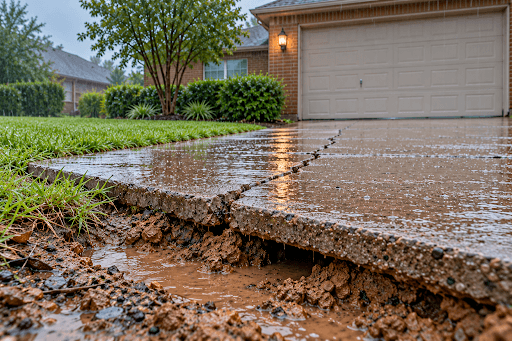
A driveway that appeared stable throughout the summer may develop a new crack after several heavy storms. A patio may begin holding water where it never did before, or a sidewalk may develop an uneven transition that becomes noticeable after the ground has been saturated. It is natural to assume that the recent rainfall caused the damage. In some cases, however, the problem began much earlier, when dry conditions changed the moisture content and volume of the soil beneath the concrete.
Throughout Houston and Southeast Texas, expansive clay soils can respond significantly to changes in moisture. During dry periods, certain soils shrink. When substantial rainfall returns, those same soils may absorb water and expand. At the same time, concentrated runoff can carry soil particles away from beneath concrete, creating a different type of support problem. Understanding what happens during the transition from drought to heavy rain helps explain why concrete sometimes moves, cracks, or settles even when the slab itself remains structurally sound.
Why Houston’s Soil Reacts to Changes in Moisture
Much of the Houston region contains clay-rich soils, including expansive clays that can change volume as moisture conditions fluctuate. Clay particles have properties that allow certain soils to absorb water and swell. When moisture is lost, those soils may contract and occupy less volume. This behavior differs from that of many granular soils, such as clean sand and gravel, which generally experience less volume change from ordinary moisture fluctuations.
The amount of movement depends on the soil’s mineral composition, density, moisture content, depth, confinement, and surrounding conditions. Not every property in Houston contains the same soil, and not every clay-rich soil behaves identically. However, expansive soil behavior is common enough in Southeast Texas that moisture changes deserve consideration when evaluating concrete movement. For concrete slabs supported by shallow soils, changes in moisture can influence the support conditions beneath the surface.
What Happens Beneath Concrete During an Extended Drought?
During prolonged dry weather, moisture gradually leaves exposed soil through evaporation and plant activity. Vegetation can also remove water from the ground through its root systems. As expansive clay loses moisture, it may shrink. The resulting volume change can create gaps, cracks, or differential movement within the soil. In some situations, the ground pulls away from the underside of a slab or changes elevation enough to reduce support beneath certain areas.
Concrete does not shrink and swell in the same way as expansive clay. As a result, the slab may respond differently from the material supporting it. One portion of a driveway may remain supported while another experiences movement. A patio may develop stress near a corner, or a sidewalk may begin settling along an edge where moisture conditions differ from those beneath the center. These changes can occur gradually, making them difficult to recognize until a crack or elevation difference becomes visible.
Why Soil Moisture Is Rarely Uniform Beneath a Slab
Even when a property experiences the same weather conditions across the entire lot, moisture beneath the concrete may vary considerably. Soil near exposed slab edges can lose moisture more readily than soil protected beneath the center of a large concrete surface. Trees and landscaping may influence moisture levels in localized areas, while irrigation systems can keep some portions of the ground wetter than others. Roof runoff, downspouts, grading, and nearby drainage features can also create differences. This uneven distribution matters because differential soil movement is often more damaging to concrete than uniform movement.
If the ground beneath an entire slab rises or falls by approximately the same amount, the concrete may experience relatively little bending. When one area moves more than another, the slab can develop stress that leads to cracking, separation, or uneven elevations. That is why a driveway may crack along one side while the other remains relatively stable.
What Happens When Heavy Rain Returns After a Drought?
When significant rainfall follows an extended dry period, moisture begins moving back into the soil. The response depends on soil conditions, rainfall intensity, drainage, existing cracks, and how quickly water can penetrate the ground. Some expansive clay soils absorb water and swell as their moisture content increases. This can create upward movement beneath concrete, particularly where wetting occurs unevenly.
However, heavy rainfall does not necessarily produce uniform swelling. Water may enter more rapidly near exposed edges, cracks, utility trenches, and drainage pathways than beneath the center of a slab. The result can be changing support conditions over a relatively short period.
A slab that experienced one pattern of soil movement during drought may respond to a different pattern as moisture returns. In some cases, cracks become more noticeable because the supporting ground is moving again. In others, water enters existing openings and contributes to erosion or additional settlement. The important distinction is that rainfall can trigger several different soil processes, not all of which involve the same type of movement.
Can Heavy Rain Make Previously Dry Clay Expand?
Yes. Certain expansive clay soils can swell when they absorb water after a dry period. This swelling can influence shallow concrete slabs, pavement, and other structures supported by the soil.
However, the amount and direction of movement depend on the soil’s properties and surrounding conditions. A section of soil that has dried substantially may have more potential to change volume when moisture returns than an adjacent section that remained relatively wet. That difference can create uneven movement beneath the concrete.
It is also possible for rainfall to affect the soil without producing enough expansion to cause visible damage. For this reason, a crack appearing after heavy rain should not automatically be attributed to clay swelling. Other causes, including erosion, poor compaction, structural loading, and normal concrete behavior, may need to be considered.
Why Concrete Can Crack When Soil Swells Unevenly
Concrete performs well under compression but has comparatively limited tensile strength. When supporting soil moves unevenly, the slab may experience bending and tension. If those stresses exceed the concrete’s capacity, cracking can occur.
For example, moisture may reach the soil along one edge of a driveway more quickly than beneath the center. If the edge soil expands while the center remains relatively unchanged, the resulting difference in support can place stress on the slab. A similar condition can develop near patios, sidewalks, garage approaches, and pool decks.
The location and pattern of cracking can provide clues, but they do not establish the cause by themselves. Concrete also cracks because of shrinkage, temperature changes, inadequate joints, loading, and other factors unrelated to expansive soil. A proper evaluation considers the slab’s condition, movement history, drainage, and surrounding ground conditions.
Drought Can Also Create Conditions for Soil Erosion
One of the less obvious consequences of extended dry weather is the development of cracks and openings within the soil. As certain clay soils shrink, fissures may form. These openings can create pathways for water when heavy rain eventually returns.
Rainwater may move through surface cracks, along slab edges, or into disturbed fill rather than soaking evenly into the ground. If the water begins carrying fine soil particles through these pathways, erosion can occur. This is a different process from clay swelling. Swelling changes the volume of soil that remains in place. Erosion removes soil particles from the supporting area. Both processes can influence concrete, but they may require different corrective measures.
Why Some Concrete Sinks After Heavy Rain Instead of Rising
Property owners sometimes hear that clay expands when wet and understandably wonder why their concrete is sinking rather than lifting. The answer is that rainfall can produce several competing effects. Some soil may swell as moisture increases, while other material may soften, consolidate, or be transported away by moving water. Poorly compacted fill may settle when saturated. Fine soil particles may migrate through drainage pathways. Existing underground voids may become larger as additional material is removed.
A slab can also settle after previously unsupported material shifts or collapses. This is why concrete movement should not be diagnosed solely from recent weather conditions. The direction of movement, location of the damage, condition of the soil, and presence of drainage or erosion pathways all matter.
How Water Moves Beneath Driveways and Patios
Driveways, patios, and other concrete surfaces change how rainwater reaches the ground. Rather than soaking evenly through the surface, water typically runs toward edges, joints, drains, and lower areas. If grading directs runoff toward a driveway edge, repeated storms can concentrate water along the supporting soil. Water may also enter through cracks, expansion joints, gaps near garage approaches, or areas where utility trenches cross beneath the concrete.
Once underground, the water can follow pathways created by differences in soil density, previous excavation, or existing voids. In some situations, those pathways allow fine soil particles to migrate away. Over time, the loss of support can cause settlement even when the concrete itself remains in relatively good condition.
Why Driveways Often Show the First Signs of Movement
Driveways are particularly vulnerable to differential soil conditions because they cover relatively large areas and often connect structures supported in different ways. The driveway may be a separate slab from the garage floor or home foundation. Its supporting soil may also include disturbed construction fill, utility trenches, and areas exposed to concentrated runoff.
During drought, soil near exposed driveway edges may dry more rapidly than soil beneath the center. When heavy rain returns, water may enter along those same edges or through existing cracks and joints. These changing conditions can contribute to uneven movement.
A growing gap near the garage, a sinking section near the street, new cracks, or a change in drainage can all indicate that the supporting ground deserves attention. However, driveway settlement does not automatically mean the home’s structural foundation is failing.
Pool Decks Can Be Especially Sensitive to Moisture Changes
Pool decks exist in an environment where water is frequently present even during dry weather. Splash-out, irrigation, plumbing, landscaping, and drainage can create moisture conditions that differ from those in other parts of the yard.
During drought, exposed soil around the deck may shrink while areas near the pool remain comparatively moist. When heavy rain returns, those differences can change again. If the deck was constructed over disturbed or poorly compacted fill, settlement may also occur independently of expansive clay behavior.
Pool deck movement can produce uneven transitions, cracks, gaps, and changes in drainage. These symptoms should be evaluated carefully because the deck, pool shell, coping, plumbing, and surrounding soil are separate components that may respond differently.
Why Sidewalks and Patios Develop Uneven Sections
Sidewalks and patios are often supported by relatively shallow prepared bases. Because they are exposed to moisture changes along their edges, localized soil movement can create uneven elevations between adjacent slabs. A sidewalk panel may rise or settle relative to the next panel. A patio may develop a slope toward the house or begin holding water near one corner.
Not every uneven section is caused by drought and rainfall. Tree roots, poor construction, inadequate compaction, drainage problems, and long-term settlement can produce similar symptoms. The important question is whether the concrete itself is deteriorating or whether the support beneath it has changed. That distinction influences whether leveling, stabilization, drainage correction, or replacement is appropriate.
Can Concrete Settlement Continue After the Rain Stops?
Yes. Soil moisture does not necessarily return to equilibrium immediately after a storm. Water may continue moving through the ground, collecting in low-permeability areas, or draining along underground pathways after surface conditions appear dry. Some soils respond gradually as moisture redistributes. If erosion has removed material, the resulting void remains even after the water is gone. Similarly, poorly compacted fill may continue consolidating after becoming saturated. This means concrete movement can become noticeable days or weeks after a major rainfall event rather than during the storm itself. A delayed response does not automatically establish the cause. It does reinforce the importance of considering underground conditions rather than focusing only on the weather visible at the surface.
What Warning Signs Should Houston Property Owners Watch For?
After a prolonged dry period followed by heavy rainfall, property owners should pay attention to changes in concrete elevation and drainage. New or widening cracks, uneven slab transitions, growing gaps beneath concrete edges, recurring low spots, and areas where soil appears to be disappearing may indicate that support conditions have changed. Standing water can also provide useful information. If a driveway or patio previously drained correctly but now holds water, the surface may have shifted. A crack that develops vertical displacement deserves more attention than a narrow, stable surface crack. Property owners should also notice whether the same area changes after repeated wet and dry cycles. Photographs taken from consistent locations can help document movement and provide useful information during a professional evaluation.
Does Every Crack After a Drought Mean the Soil Is Failing?
No. Concrete cracks for many reasons, and some cracking is expected during the life of a slab. Shrinkage during curing, temperature changes, loading, inadequate joint placement, and normal aging can all contribute. The timing of a crack may suggest a possible connection to weather, but timing alone does not prove causation.
A small crack that remains stable may be primarily a maintenance concern. A crack accompanied by vertical movement, recurring settlement, visible soil loss, or changing drainage may indicate a more significant support issue. The appropriate response depends on the condition of the slab and whether movement is continuing or not.
How Polyurethane Injection Can Help When Support Is Lost
When concrete settlement results from underground voids or loss of support, polyurethane injection may provide a way to stabilize the affected area without replacing otherwise serviceable concrete. PolyTex Concrete uses specialized polyurethane materials that can be introduced beneath concrete through carefully located injection points. As the material reacts and expands, it can fill available void space and help restore support beneath the slab.
In suitable conditions, controlled expansion may also allow settled concrete to be carefully lifted toward its intended elevation. This can be valuable for driveways, sidewalks, patios, pool decks, garage floors, and commercial concrete surfaces. However, polyurethane does not prevent expansive clay from responding to future moisture changes. It also does not automatically correct drainage problems, underground leaks, or ongoing erosion. The suitability of injection depends on the cause of movement and the conditions beneath the concrete.
Soil Stabilization and Concrete Leveling Are Not Always the Same Thing
Concrete leveling focuses on correcting the elevation of a settled slab. Soil stabilization focuses on improving the support conditions within an affected area. The two services are related, but they are not interchangeable. A slab may still be relatively level even though a void has developed underneath it. In that situation, filling the void and restoring support may be more important than lifting. Another slab may have already settled because supporting material has been lost. That project may involve both void filling and controlled lifting. Understanding the difference helps property owners evaluate the repair based on the actual condition rather than simply choosing a method because the concrete looks uneven.
Why Drainage Should Be Part of the Conversation
If concentrated runoff is washing soil away from beneath concrete, restoring support without addressing the water pathway may leave the original problem active. Downspouts, grading, drainage outlets, irrigation leaks, and underground plumbing can all influence moisture conditions. Some properties may require drainage improvements or plumbing repairs before or alongside concrete stabilization. In other situations, soil movement may be primarily related to expansive clay behavior rather than an identifiable erosion pathway. There is no universal repair method that eliminates every effect of drought and heavy rainfall. The goal is to determine which conditions are contributing to the movement and address those issues that can be corrected.
When Concrete Replacement May Be Necessary
Polyurethane leveling is not appropriate for every damaged slab. Concrete that is severely deteriorated, extensively fractured, structurally compromised, or otherwise unsuitable for lifting may need replacement. Even then, the supporting soil should be evaluated before new concrete is installed. Replacing a slab without addressing unstable fill, significant voids, or active erosion can expose the new concrete to similar conditions.
For properties affected by expansive soil, appropriate base preparation, drainage considerations, and construction practices are especially important. A responsible repair recommendation considers both the condition of the concrete and the ground beneath it.
Why the Drought-to-Rain Transition Deserves Attention
Houston’s changing weather conditions create a useful reminder that soil is not a fixed, unchanging foundation beneath exterior concrete. During drought, expansive soils may shrink and develop cracks. When heavy rain returns, moisture conditions can change quickly, causing some soils to swell while runoff and underground water movement may contribute to erosion elsewhere. The resulting concrete movement can be complex.
A driveway may crack because support changed unevenly. A patio may settle because soil was washed away. A sidewalk may develop a raised transition because one area moved differently from another. The visible symptom does not always reveal which process occurred. That is why understanding the cause matters more than simply identifying the most recent weather event.
The Weather Changes. Your Concrete Support Shouldn’t Be an Afterthought.
Drought and heavy rainfall are part of life in Houston and Southeast Texas. While property owners cannot control those conditions, they can pay attention to how their concrete responds and address support problems when they develop. New cracks, recurring settlement, gaps beneath slabs, and changes in drainage may indicate that the ground supporting the concrete deserves closer evaluation.
PolyTex Concrete provides polyurethane concrete leveling, void filling, and soil stabilization throughout Houston, Conroe, The Woodlands, Galveston, Clear Lake, and surrounding Southeast Texas communities.
When the existing concrete remains suitable for repair, targeted stabilization may help restore support without automatically requiring full replacement. If your driveway, patio, sidewalk, pool deck, or commercial slab has started moving after a long dry period followed by heavy rain, the most important question is not simply what happened to the concrete, it’s what happened to the ground underneath it.
Contact PolyTex Concrete for a free quote and evaluation.