
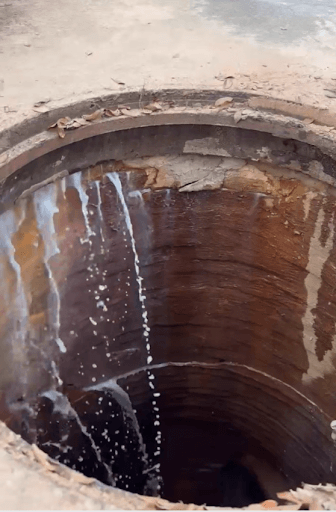
A depression forming around a manhole may look like a pavement problem and sometimes it is, but when asphalt or concrete repeatedly settles around a manhole, storm drain, sewer structure, or other underground utility, the visible damage at the surface may be only one part of the problem. The real issue can be several feet below.
Water moving through the surrounding soil, poorly compacted backfill, leaking joints, deteriorating infrastructure, or soil migrating into openings can gradually remove support around an underground structure. As that support disappears, pavement above it can begin to crack, settle, or form a depression.
For municipalities, utility districts, commercial property owners, engineers, and public works departments throughout Houston and Southeast Texas, recurring settlement around underground infrastructure deserves more than another surface patch.
Understanding why the ground is moving is the first step toward determining the right repair.
Why Does Pavement Settle Around Manholes?
Installing a manhole requires excavation. A hole considerably larger than the structure itself must be created so the manhole can be installed and connected to the surrounding system. Once construction is complete, the space around the structure is backfilled and compacted. That means the soil immediately surrounding a manhole has been disturbed. If the backfill is not compacted uniformly, or if it consolidates over time, small spaces can develop beneath the pavement.
Water can make the problem significantly worse. Once water begins moving through disturbed soil, it can transport fine soil particles, enlarge existing pathways, and gradually create underground voids. Eventually, the pavement above loses support.
The Surface Depression May Be a Symptom
One of the most important things to understand about manhole settlement is that the visible depression is not necessarily the entire problem. Imagine a section of roadway that has dropped two inches around a manhole. It might be tempting to simply add asphalt and restore the road surface.
But why did that pavement drop? If the underlying soil has consolidated and stabilized, a surface repair may be appropriate. If soil is actively washing away beneath the pavement, however, adding material to the surface does nothing to restore the missing support below. The road may look repaired while the underground void continues to grow. That is why recurring settlement deserves additional investigation.
Water Is Often the Driving Force
Water is one of the most powerful forces affecting underground infrastructure. Houston and Southeast Texas experience periods of intense rainfall capable of moving enormous amounts of stormwater through municipal drainage systems. That water does not always remain exactly where engineers intended it to travel.
Leaks, separated joints, cracks, penetrations, deteriorated seals, and changes in surrounding soil can allow water to move outside a pipe or structure. Once water begins traveling through surrounding fill, it may carry soil particles with it. This process can gradually create a pathway through the ground. As more soil migrates, the pathway can become larger. Eventually, a significant void may develop.
Soil Can Also Migrate Into the Infrastructure
Water does not have to leak outward to create a problem. In some situations, groundwater or stormwater outside the structure can carry surrounding soil into a sewer, stormwater system, pipe joint, or manhole. Fine particles migrate with the water. The water continues through the system. The soil does not return.
Over time, material is removed from the area surrounding the structure. This type of underground soil migration can be difficult to recognize from the surface because the pavement may remain intact while support slowly disappears underneath it.
Eventually, cracking or settlement provides the first obvious indication that something has changed.
Poorly Compacted Backfill Can Contribute to Settlement
Not every manhole settlement problem involves active erosion. Sometimes the original construction conditions are responsible. Soil placed around underground infrastructure must be properly compacted. If backfill is installed in lifts that are too thick, contains unsuitable material, or does not receive adequate compaction, it may continue consolidating after construction.
Vehicle traffic can accelerate the process. As the soil becomes denser, its volume decreases. The pavement above follows it downward. This can create the familiar ring-shaped depression often seen around manholes in roadways and parking lots.
Determining whether the issue involves simple consolidation or active soil loss is important because the repair strategy may be different.
Houston’s Expansive Clay Adds Another Variable
The Houston region is well known for expansive clay soils. These soils respond significantly to changing moisture conditions. As moisture increases, clay can expand. During dry periods, it can contract.
Underground utility construction introduces different materials, disturbed soil, pipe bedding, and backfill into this naturally variable environment.
Water may move differently through a utility trench than it does through undisturbed surrounding soil. The trench can sometimes become a preferential pathway that allows water to travel along the underground infrastructure. That means a problem visible around one manhole may be connected to soil or water movement occurring farther along the utility corridor.
Why Do Repairs Sometimes Keep Failing?
Recurring settlement is information. If the same area around a manhole has been patched repeatedly, something may still be moving beneath the surface.
Adding asphalt can restore the driving surface. Replacing a small section of concrete can restore the pavement. Neither automatically replaces soil that has disappeared several feet underground.
If an underground void remains, the new pavement may eventually lose support just like the material it replaced. That does not mean every failed patch indicates a large underground problem. It means repeated movement should raise the question: Why does this location keep settling? Finding that answer can prevent a cycle of repairing the same symptom again and again.
What Are the Warning Signs of a Developing Void?
Settlement around a manhole can appear in several ways. Crews and facility managers may notice pavement sloping toward the structure, a growing depression around the frame, recurring cracking, gaps between pavement and the manhole, or repairs that repeatedly sink. Standing water can also become a clue. If a roadway or parking area that previously drained correctly begins collecting water around a manhole, the drainage system may not be the only thing that changed. The pavement elevation itself may have dropped.
More significant soil loss may create hollow areas, larger cracks, or sudden pavement failure. The earlier these conditions are investigated, the more options may be available for addressing them.
Why Underground Voids Matter
A small void does not automatically mean a roadway is about to collapse. But unsupported pavement behaves differently from pavement resting on a properly compacted base.
Roadways and parking areas are designed to transfer vehicle loads through the pavement and into the materials below. If part of that support disappears, loads are redistributed.
Traffic can repeatedly stress the unsupported area. As the void expands, the pavement may crack, deform, or eventually fail. This becomes particularly important on roads carrying heavy trucks, buses, emergency vehicles, or industrial traffic.
Restoring underground support can therefore be just as important as restoring the surface elevation.
How Polyurethane Injection Can Help
When conditions are appropriate, polyurethane injection can provide a way to fill underground voids and stabilize compromised soils without excavating the entire surrounding area.
PolyTex Concrete uses specialized polyurethane materials that can be injected into targeted areas beneath pavement and around infrastructure. Once injected, the material reacts and expands.
Depending on the project conditions and repair objectives, polyurethane can help fill voids, occupy spaces created by soil loss, improve support beneath pavement, and stabilize loose or compromised surrounding materials. This approach can be especially valuable when excavation would require significant roadway closures, pavement removal, traffic control, or disruption to active facilities.
Void Filling Is Not the Same as Fixing a Failed Pipe
This distinction is critical. Polyurethane injection can repair the consequences of soil loss, but the source of that soil loss must also be considered. If a sewer line is actively leaking, the line may need to be repaired. However if a stormwater structure has a failed joint, that joint may need attention. And if water is entering through a damaged connection, stopping the water pathway may be necessary before or in conjunction with soil stabilization.
Polyurethane is not a substitute for repairing structurally failed infrastructure.
The strongest repair plan identifies both:
- Why the soil disappeared.
- How to restore the support that was lost.
Municipal projects may therefore involve coordination between PolyTex, public works personnel, utility contractors, engineers, inspectors, and other specialists.
Why Polyurethane Can Be Useful Around Active Infrastructure
Traditional repairs involving excavation can become complicated quickly. Excavating around a manhole may require removing pavement, establishing traffic control, exposing utilities, removing compromised material, replacing and compacting backfill, rebuilding the pavement section, and reopening the area after the repair is complete. Sometimes that is exactly what the project requires. But when the underground structure remains serviceable and the primary problem involves surrounding voids or lost soil support, targeted polyurethane injection may offer a less disruptive alternative. Small injection points can allow material to reach below the pavement without removing large sections of roadway.
For municipalities and commercial facilities, reducing excavation can mean less disruption to traffic and operations.
Manholes Aren’t the Only Infrastructure at Risk
The same underground processes can affect many types of infrastructure.
PolyTex may encounter soil loss or void formation around:
- Storm drains
- Catch basins
- Sewer structures
- Culvert pipes
- Drainage structures
- Utility vaults
- Pipe crossings
- Roadway approaches
- Bridge approaches
- Commercial drainage systems
- Industrial infrastructure
The geometry changes, but the underlying principle remains the same.
When water moves soil away from infrastructure, something must eventually replace the support that was lost.
Culverts and Manholes Can Experience Similar Soil Migration
There is an important relationship between manhole settlement and culvert erosion. In both situations, water is moving through infrastructure surrounded by soil. If water begins traveling outside the intended system, it can transport surrounding material and create underground voids.
A culvert may show soil loss around the pipe or settlement above it. A manhole may develop a depression in the pavement surrounding the structure. Both conditions can be symptoms of underground soil migration. This is why understanding water movement is so important in infrastructure stabilization. The visible damage tells you where the problem appeared. It does not always tell you where the problem started.
What Should Municipalities and Property Owners Do When Settlement Appears?
Start by documenting the condition. Photographs, measurements, maintenance records, and previous repair history can help determine whether settlement is progressing. Look for patterns. Has the area been patched before? Does the settlement worsen after heavy rain? Is water collecting around the structure? Are nearby pavement sections also moving? Have underground utilities in the area been repaired recently? Is there evidence of soil entering the drainage or sewer system? These observations can help determine whether the problem is primarily pavement-related or whether additional underground investigation is warranted.
When Should an Engineer Be Involved?
Not every settlement issue requires an engineering investigation, but infrastructure projects can involve conditions beyond the scope of concrete leveling or soil stabilization alone.
Significant structural deterioration, major roadway failures, suspected pipe collapse, large underground voids, or complex municipal infrastructure may require evaluation by a licensed professional engineer or other appropriate specialist.
PolyTex works within the appropriate scope of each project and can coordinate with engineers, contractors, municipalities, and property owners when additional expertise is needed. The objective is not to force every problem into the same repair method, but to identify the right solution for the actual conditions underground.
PolyTex Concrete Provides Infrastructure Soil Stabilization Throughout Southeast Texas
PolyTex Concrete provides polyurethane injection, void filling, concrete leveling, and soil stabilization services for municipal, commercial, industrial, and infrastructure applications throughout Houston and Southeast Texas. Our work can include stabilization around manholes, drainage structures, culverts, roadways, parking areas, commercial properties, industrial facilities, and other locations where underground soil loss has compromised support.
If pavement continues settling around a manhole or drainage structure, another surface patch may not answer the most important question. What is happening underneath it?
PolyTex can help evaluate the conditions below the surface and determine whether polyurethane void filling or soil stabilization may be an appropriate part of the repair.
Contact PolyTex Concrete to discuss your infrastructure stabilization project or request an evaluation.