
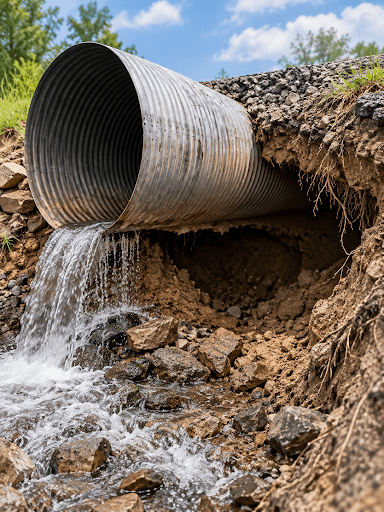
A culvert pipe is supposed to move water safely beneath a driveway, roadway, parking area, or other structure. When everything is functioning correctly, water enters one side of the culvert, passes through the pipe, and exits without disturbing the soil supporting the surrounding area. When something changes, however, water can begin traveling where it was never intended to go.
Property owners may first notice a small depression beside the pipe. Soil seems to disappear after every heavy rain. Pavement above the culvert begins cracking, or a hole develops near the inlet or outlet. In more advanced situations, the ground may begin settling around the pipe or a significant underground void can develop. These are not simply cosmetic drainage problems. Soil washing away around a culvert can indicate that water is carrying away material needed to support the pipe, pavement, driveway, or surrounding infrastructure.
Throughout Houston, Galveston, Conroe, The Woodlands, and surrounding Southeast Texas communities, heavy rainfall and concentrated stormwater make culvert erosion an important issue for residential properties, commercial sites, HOAs, industrial facilities, and municipalities.
Understanding where the water is going and why the soil is moving is the first step toward determining the right repair.
Why Does Soil Wash Away Around Culvert Pipes?
A culvert intentionally concentrates water. Instead of allowing stormwater to spread across a wide area, the drainage system collects that water and moves it through a relatively confined opening. That makes the condition of the pipe and surrounding soil especially important. Ideally, water remains inside the culvert for the entire length of the system. If water begins escaping through damaged areas, separated joints, gaps, or pathways along the outside of the pipe, it can begin interacting with surrounding soil.
Repeated water movement can carry fine particles away. The process may begin slowly, but every storm can remove additional material and enlarge the pathway. Eventually, what started as minor soil migration can become a substantial underground void.
Water Traveling Outside the Pipe Is a Warning Sign
One of the most important concepts in culvert erosion is sometimes called piping or internal erosion. In simple terms, water finds a pathway through or along the surrounding soil and begins carrying material with it. Instead of all the water moving through the culvert, some may travel along the outside of the pipe or through openings in the surrounding area. Once a pathway becomes established, future water tends to follow it. As more soil is removed, the pathway can become easier for water to enter, accelerating the process.
Property owners may not see this underground movement directly. Instead, they see the results: depressions, sinkhole-like openings, soil loss, cracked pavement, or settlement above the culvert.
Culvert Joints Can Become Part of the Problem
Many culvert systems consist of multiple pipe sections connected together. If those connections separate or allow water to escape, surrounding soil can begin migrating toward the opening. The problem can occur with different types of culvert materials and configurations. The important issue is not simply what the pipe is made from, but whether water is staying where the drainage system was designed to carry it. A failed or separated joint can create an underground entry point that is difficult to see from the surface. Over time, soil surrounding the pipe may be carried into the culvert and transported downstream. The empty space left behind can continue growing until surface settlement becomes visible.
Heavy Rain Can Accelerate Existing Problems
Houston and Southeast Texas can experience intense rainfall events that place substantial demands on drainage infrastructure. A culvert that appears relatively stable during ordinary conditions may experience much greater water volume and velocity during a major storm.
If an erosion pathway already exists, heavy rain can accelerate soil loss significantly. This is why property owners sometimes report that a depression or hole seemed to appear almost overnight after a storm. The underlying problem may have existed much longer, but the rainfall event removed enough additional material for the surface to finally respond.
After significant storms, inspecting culvert areas for new soil loss, depressions, exposed pipe sections, and pavement changes can help identify problems earlier.
Erosion at the Inlet and Outlet Can Work Its Way Toward the Pipe
Not all culvert erosion begins underground. Water entering or leaving the culvert can also erode exposed soil around the inlet and outlet. High-velocity discharge can scour soil downstream, while poorly controlled water entering the pipe can damage material around the upstream opening. If that erosion reaches the sides or underside of the culvert, support conditions can begin changing.
Visible erosion around either end of the pipe should not automatically be treated as a landscaping issue. It may indicate that the drainage system is affecting the structural support surrounding the culvert.
What Happens When a Void Forms Around a Culvert?
As soil disappears, the pipe and the surface above it may lose support. The exact symptoms depend on the culvert’s depth, size, material, surrounding soil, and what is located above it. A culvert beneath a residential driveway presents different consequences than a large drainage structure beneath a commercial truck route or municipal roadway.
Common signs can include:
- Depressions above or beside the culvert
- Soil disappearing around the inlet or outlet
- Cracking in pavement above the pipe
- Settlement in a driveway or roadway
- Gaps forming along the pipe
- Sinkhole-like openings
- Water emerging from unexpected locations
- Repeated erosion after storms
- Visible voids around exposed sections of pipe
- Recurring pavement or surface repairs
These symptoms deserve investigation because the visible opening may represent only part of the underground soil loss.
The Surface Can Look Fine While a Void Develops Below
One of the more concerning characteristics of underground erosion is that the pavement or concrete above it may initially remain intact.
Concrete and pavement systems can sometimes bridge across unsupported areas. From the surface, traffic continues moving normally while soil gradually disappears below. Eventually, the unsupported area may become too large or loads above it may exceed what the remaining structure can carry. Settlement or cracking then appears at the surface. This is why known soil loss around a culvert should not be ignored simply because the roadway or driveway still looks relatively level.
The absence of visible settlement does not prove that full support remains beneath it.
Residential Driveway Culverts Can Develop the Same Problem
Culvert erosion is not limited to highways and municipal drainage systems. Many residential properties use culverts beneath driveway entrances to carry stormwater through roadside ditches. These systems may seem simple, but they experience the same basic forces of flowing water and soil movement.
Homeowners may notice dirt disappearing beside the driveway, a hole developing near the culvert end, or concrete or asphalt beginning to settle above the pipe. Repeatedly adding dirt to the hole may temporarily improve the appearance, but if water continues carrying that material away, the underlying problem remains. Understanding why the soil keeps disappearing is more important than simply replacing what was lost at the surface.
Commercial Properties Have More at Risk
Commercial sites may have culverts beneath access roads, parking lots, truck courts, drainage crossings, and other heavily traveled areas. Settlement in these locations can interfere with traffic, create maintenance concerns, and affect business operations. Heavy vehicles can also place significant loads above areas where underground support has been compromised.
Because commercial drainage systems often manage runoff from large roofs and extensive paved areas, water volume can be substantial during storms.
Early evaluation can help facility managers understand whether visible erosion represents a localized surface problem or a larger void beneath the pavement.
Municipal Culverts Require a Broader Infrastructure View
Municipal drainage infrastructure adds another level of complexity because culvert conditions may affect roads, sidewalks, utilities, stormwater systems, and public access.
Polyurethane injection can be useful for appropriate void-filling and soil-stabilization applications, but the condition of the overall culvert system still matters. If the pipe is structurally compromised, improperly sized, severely displaced, or affected by another design issue, additional engineering or infrastructure work may be necessary.
PolyTex’s role is not to treat every culvert problem as an injection project. The objective is to identify where polyurethane can appropriately stabilize compromised soils and fill voids as part of the larger repair strategy.
Why Dumping More Soil Into the Hole Often Doesn’t Work
This is one of the most common responses to visible culvert erosion. A depression appears, so someone fills it with dirt or gravel. After another few storms, the material disappears and the hole returns. That should tell you something important: the material is going somewhere. It may be moving into an underground void, entering the culvert through an opening, or being transported downstream by water.
Adding more material from the surface does not necessarily reach the entire underground space, and loose fill can be vulnerable to the same water movement that removed the original soil. Until the pathway causing the soil migration is understood, repeated surface filling may provide only temporary results.
How Polyurethane Injection Can Help Stabilize Culvert Voids
For suitable applications, PolyTex can use polyurethane injection to reach compromised areas around culvert structures without excavating the entire system. Injection points are strategically located to introduce polyurethane into underground voids and unstable zones. Depending on the material and project design, the polyurethane can expand into available spaces and help stabilize surrounding soil.
This process may help:
- Fill underground voids
- Restore lost support
- Stabilize loose or compromised soil
- Reduce pathways for continued soil migration in treated areas
- Support pavement or concrete above the culvert
- Reach difficult underground spaces
- Minimize excavation and surface disruption
Every culvert project is different, so the injection pattern and repair objectives should be based on actual site conditions rather than a one-size-fits-all approach.
Polyurethane Is Not a Substitute for a Failed Pipe
This distinction is critical. If a culvert is severely damaged, collapsed, structurally inadequate, or otherwise incapable of performing its intended function, filling surrounding voids does not magically repair every problem with the pipe. Likewise, if uncontrolled water continues entering an area through a major defect, the water pathway must be addressed.
Polyurethane injection is a soil stabilization and void-filling technology. It can be extremely valuable as part of culvert repair, but the entire drainage system needs to be considered. In more complex projects, that may involve coordination with engineers, drainage contractors, municipalities, general contractors, or other professionals.
Why Excavation Isn’t Always the Best First Option
Traditional culvert repairs can become disruptive quickly, especially when the affected area sits beneath a roadway, driveway, parking lot, or active commercial site. Reaching an underground void through excavation may require removing pavement, closing traffic lanes, digging around the culvert, replacing soil, recompacting the area, and reconstructing the surface above.
There are situations where excavation is absolutely necessary. However, when the culvert remains appropriate for continued service and the primary issue is soil loss or void formation around it, polyurethane injection may offer a less invasive stabilization option. Preserving the existing surface can reduce disruption and help avoid unnecessary reconstruction.
The Cause and the Void Both Need Attention
A successful culvert stabilization project should answer two questions: why did the soil disappear, and what support needs to be restored? If water is escaping through a joint, that condition matters. Also, if erosion is occurring at the outlet, or if the pipe itself is damaged or you are dealing with uncontrolled runoff, that matters. At the same time, simply correcting the water source does not automatically replace soil that has already been lost. The existing void may still require stabilization.
The strongest solution addresses both sides of the problem: control the condition causing soil migration and restore the support that erosion has already removed.
When Should Culvert Erosion Be Evaluated?
Do not wait for a major surface collapse before investigating obvious soil loss. An evaluation is warranted when you notice recurring depressions, soil disappearing after storms, cracking or settlement above the culvert, gaps around the pipe, water flowing outside its intended pathway, or a hole that continues returning after being filled.
Sudden or substantial ground movement deserves particular attention. Depending on the location and severity, traffic or access over the affected area may also need to be restricted until appropriately qualified professionals determine the condition is safe.
Earlier investigation provides more information and potentially more options for repair.
Final Thoughts
When soil begins washing away around a culvert pipe, the visible erosion may be only one part of the problem. Water can travel through damaged joints, along the outside of the pipe, or through surrounding soils and gradually create underground voids that compromise support beneath driveways, parking areas, roadways, and other infrastructure. Simply replacing the missing dirt may not solve the problem if the material continues being carried away.
PolyTex Concrete provides polyurethane injection, culvert void filling, and soil stabilization solutions throughout Houston, Galveston, Conroe, The Woodlands, and surrounding Southeast Texas communities. Also, PolyTex works with residential property owners, commercial facilities, contractors, engineers, HOAs, and municipalities to address appropriate soil-loss and void conditions around drainage infrastructure.
If you are seeing recurring erosion, settlement, depressions, or soil disappearing around a culvert, schedule an evaluation with PolyTex Concrete. Finding out where the soil is going and why it is moving is the first step toward stabilizing the area before the problem becomes more extensive.