
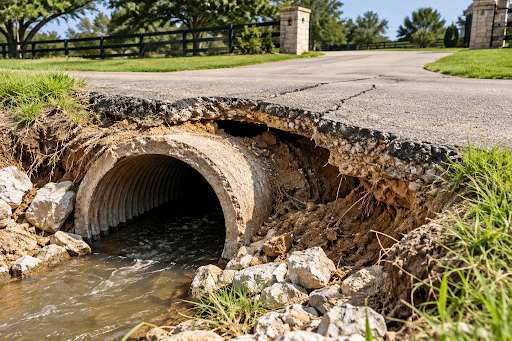
Culvert Washout Beneath Roads and Driveways: When Void Filling and Soil Stabilization Can Help
A depression appears in a roadway near a culvert crossing. The asphalt begins cracking along the edge of a driveway, or a section of concrete develops a noticeable dip after several heavy rainstorms. At first, the problem may look like ordinary pavement deterioration, but the cause could be several feet below the surface. When washout occurs beneath roads and driveways, sometimes void filling and soil stabilization can help without the need to replace the affected area.
Culvert pipes carry stormwater beneath roads, driveways, parking areas, and other developed surfaces. When these systems function properly, water passes through the pipe while the surrounding soil and backfill provide support for the pavement above. However, damaged joints, deteriorated pipes, poorly compacted fill, and uncontrolled water movement can compromise that support. As soil migrates away from the culvert, underground voids can develop. The road or driveway may remain intact for a period of time before cracking, settling, or experiencing more serious structural distress.
For municipalities, commercial property owners, industrial facilities, and homeowners throughout Houston and Southeast Texas, understanding the relationship between culvert washout and pavement support is essential. The appropriate repair may involve culvert rehabilitation, drainage correction, excavation, void filling, soil stabilization, or a combination of methods. The goal is not simply to repair the visible depression, but to determine why the ground beneath the roadway or driveway has changed.
Why Culverts Are Critical to Roadway and Driveway Stability
A culvert is designed to move water beneath an obstruction such as a roadway, driveway, railroad, or embankment. Culverts may be constructed from reinforced concrete, corrugated metal, high-density polyethylene, or other materials selected for the site’s hydraulic and structural requirements. Although the pipe carries water, the surrounding soil is equally important to the performance of the crossing.
Properly installed bedding and backfill help support the pipe and distribute loads from the pavement and vehicles above. The culvert, surrounding soil, and roadway structure work together as a system. When the supporting material remains stable, the crossing can function for many years. When water begins removing soil from around the pipe, however, the relationship between the culvert and the pavement changes.
A culvert may continue transporting water even as the soil above or beside it becomes compromised. This is one reason pavement settlement can sometimes become the first visible indication of a problem underground.
What Is Culvert Washout?
Culvert washout occurs when water movement erodes or transports soil from around a culvert, its inlet or outlet, or the surrounding embankment and backfill. The process can occur in several ways. Water flowing through a damaged joint may escape into surrounding soil. Stormwater moving along the outside of a culvert may carry fine particles away. Concentrated flow at an inlet or outlet can erode material supporting the pipe or roadway embankment.
In some cases, water follows a pathway through inadequately compacted or poorly protected backfill. Under suitable hydraulic conditions, fine particles can migrate along that pathway, gradually reducing the amount of material available to support the crossing. The result may be a localized void, a larger area of weakened backfill, or progressive erosion that eventually affects the surface.
Culvert washout should not be confused with every form of settlement near a drainage pipe. Poor compaction and natural consolidation can also cause the ground to move without significant soil being carried away. Identifying the mechanism matters because replacing missing material without controlling an active erosion pathway may not provide a lasting solution.
How Underground Voids Develop Above a Culvert Pipe
A culvert crossing typically includes the pipe, bedding material, compacted backfill, roadway base, and pavement surface. Each layer contributes to the support of the layers above it. If soil begins migrating away from the pipe, a small opening may form within the surrounding material. As water continues moving through the area, additional particles can be transported, allowing the void to expand. The soil above may gradually settle into the opening, creating a larger zone of disturbed material. Eventually, the roadway base may lose enough support that the pavement begins moving.
The surface response depends on the pavement material, thickness, loading, and extent of the unsupported area. Flexible asphalt pavement may deform and develop a depression. Concrete pavement may temporarily bridge across a void before cracking or settling. In more severe situations, the unsupported material can collapse. A visible depression therefore does not necessarily indicate the full size or depth of the underground problem.
Why Heavy Rainfall Can Accelerate Culvert Problems in Southeast Texas
Houston and Southeast Texas experience rainfall events capable of producing significant stormwater runoff over short periods. During intense storms, culverts may carry substantially greater flows than they do under normal conditions. Water levels can rise rapidly, and hydraulic forces around inlets, outlets, joints, and embankments may increase. These conditions can expose existing weaknesses in a culvert crossing.
A damaged joint that allows relatively little leakage during ordinary flow may experience greater water movement during a major storm. An eroded outlet may allow additional soil to be removed from the surrounding embankment. Saturated backfill can also behave differently from material under normal moisture conditions. Repeated storms may gradually enlarge existing erosion pathways, particularly when the original cause remains unresolved. For property owners and maintenance departments, this helps explain why a roadway depression may appear or become noticeably worse after a major rainfall event.
Why a Road Can Look Normal While Soil Is Disappearing Beneath It
One of the challenges with culvert washout is that the pavement surface may not immediately reflect the condition of the soil below. Concrete and asphalt pavement systems can temporarily distribute loads across small unsupported areas. The roadway base may also bridge across an opening for a period of time. As erosion continues, however, the unsupported area can become larger and the remaining material may lose its ability to carry traffic loads.
A crack, dip, or depression may not appear until the underground support has already been compromised. This delayed surface response makes recurring soil loss around culverts especially important to investigate. Waiting until the pavement visibly collapses is not a sound maintenance strategy. Known voids, progressive settlement, or evidence of significant erosion should be evaluated before additional loading creates a more serious condition.
Warning Signs of Culvert Washout Beneath a Roadway
Roadway settlement associated with a culvert can appear in several forms. A shallow depression may develop directly above the pipe alignment. Cracks may form across the roadway near the crossing, or pavement may begin settling along one edge where soil support has been reduced.
Maintenance crews may notice repeated potholes, deteriorating shoulders, gaps near the culvert inlet, or erosion at the outlet. In some cases, the road surface develops an uneven transition that becomes more noticeable as vehicles cross the affected area.
A particularly important warning sign is recurring settlement after previous repairs. If an area has been patched or filled several times but continues moving, the supporting material and culvert condition deserve further investigation. No single surface symptom proves that a culvert is responsible. However, the location of the damage relative to the drainage crossing can provide useful information.
Driveway Culverts Can Experience the Same Problems
Culverts are not limited to municipal roads and large infrastructure projects. Residential and commercial driveways frequently cross roadside drainage ditches, channels, or other areas where stormwater must continue flowing beneath vehicle access points.
A driveway culvert may carry relatively modest flows during ordinary weather but experience significant runoff during heavy storms. If soil begins washing away around the pipe, the driveway above can lose support. Homeowners may notice the driveway sinking near the ditch, cracks forming above the culvert, a growing gap near the pipe opening, or soil disappearing from the edges of the crossing.
Commercial driveway culverts may face additional loading from delivery trucks, service vehicles, and heavy equipment. The same basic principle applies to both residential and commercial crossings: the pavement depends on stable material surrounding the culvert.
Why Culvert Joints and Connections Matter
Culverts constructed from multiple pipe sections rely on joints that must accommodate the design requirements of the system. If joints separate, deteriorate, or were improperly installed, water may escape through the connection. Under certain conditions, soil can also migrate into the pipe through the opening. This can create a pathway for material to move from the surrounding backfill into the drainage system.
The problem may become more pronounced when groundwater levels rise or when the culvert experiences high-flow conditions. However, not every joint opening causes soil erosion. The actual risk depends on the joint condition, surrounding soil, hydraulic gradient, and other site-specific factors. When settlement occurs near a culvert, examining the pipe interior and its connections can help determine whether the drainage system itself is contributing to the loss of support.
Inlet and Outlet Erosion Can Undermine a Crossing
Some culvert problems begin outside the pipe rather than along its length. At the inlet, concentrated runoff can erode soil near the entrance or along the embankment. At the outlet, high-velocity discharge may remove material from the downstream area if adequate erosion protection is not present. Over time, this erosion can work back toward the culvert or compromise nearby supporting material. Scour around the pipe opening can also leave portions of the culvert exposed or unsupported.
Depending on the site, correcting these conditions may require appropriate erosion-control measures, outlet protection, drainage improvements, or reconstruction. Polyurethane void filling may help restore support in suitable locations, but it does not replace the need to address an active hydraulic erosion problem.
Poor Backfill Compaction Can Look Like Culvert Washout
Not every depression above a culvert results from soil being carried away by water. During construction, the excavation around the culvert must be backfilled using suitable material and appropriate compaction procedures. If the fill is poorly placed or inadequately compacted, it can continue consolidating under traffic and environmental loads. This may cause pavement settlement even when the culvert remains watertight and no significant erosion is occurring.
In some situations, poor compaction and water movement can contribute to the same problem. That is why the repair process should begin with an evaluation of the culvert, surrounding material, and drainage conditions rather than assuming the pipe is leaking. The distinction can influence whether the appropriate response involves stabilization, excavation, reconstruction, or another method.
How Traffic Loads Affect Pavement Above a Culvert
Roadways and driveways must transfer vehicle loads through the pavement structure into the supporting ground. When soil support is reduced above or beside a culvert, those loads may become concentrated across smaller areas of remaining support.
Repeated vehicle traffic can accelerate cracking, deformation, or settlement. Heavy trucks, agricultural equipment, industrial vehicles, and construction traffic can create particularly demanding conditions at compromised crossings. This is one reason a relatively small underground void may become an operational concern on a commercial access road or industrial driveway.
The visible pavement condition should be considered together with the expected traffic loading and the extent of any underlying support loss.
Why Repeated Pavement Patching May Not Fix Culvert Settlement
A roadway depression can often be corrected temporarily by placing additional asphalt or repairing a concrete section. However, a surface patch does not automatically restore the material missing beneath the roadway base. If the underlying void remains, the repaired pavement may continue receiving inadequate support. If water is still moving through a defective culvert joint or eroding the embankment, the same process may continue after the surface is restored. Over time, the depression can return.
Repeated patching is not necessarily evidence that previous maintenance was performed incorrectly. It may indicate that the underlying condition has changed or was not fully identified during the earlier repair. When the same area continues settling, the maintenance history should become part of the investigation.
How Engineers and Maintenance Teams Evaluate Culvert Settlement
A reliable repair begins with understanding both the drainage structure and the surrounding ground. Depending on the site, evaluation may include visual inspection of the inlet and outlet, examination of the culvert interior, assessment of pipe joints, review of drainage patterns, and observation of pavement settlement.
CCTV inspection or other specialized methods may help identify defects within an accessible pipe. When significant voids or unstable ground are suspected, an engineer or geotechnical professional may recommend additional subsurface investigation. The depth of the culvert, condition of the pipe, extent of settlement, expected traffic loads, and evidence of active erosion all influence the repair strategy.
For public roadways and heavily trafficked crossings, traffic control and safety measures may be necessary while the affected area is evaluated. The objective is to determine whether the culvert is structurally serviceable and whether the surrounding support can be restored without extensive reconstruction.
When Polyurethane Void Filling Can Help
When an appropriate underground void has been identified and the culvert remains suitable for continued service, polyurethane injection may provide a targeted method of restoring lost support. PolyTex Concrete uses specialized polyurethane materials that can be introduced into compromised areas through carefully selected injection locations.
As the material reacts and expands, it can fill available void space and help restore support within the affected zone. For a roadway or driveway crossing, the objective may be to stabilize the supporting material beneath the pavement rather than simply lift the surface.
In some cases, carefully controlled injection may also allow suitable settled concrete to be raised. The feasibility of the work depends on the location and size of the void, surrounding soil conditions, culvert construction, loading requirements, and whether the erosion source has been addressed.
Why Injection Around Culverts Requires Careful Planning
Culverts are functioning drainage structures, and stabilization work must account for their condition and intended operation. Injection pressures and material placement must be controlled to avoid damaging the pipe, displacing surrounding components, or introducing material into the waterway.
The presence of an active flow path can complicate injection work. Water conditions, accessibility, and the possibility of material migration must be evaluated before proceeding. Projects involving public infrastructure may also require engineering review, traffic management, utility coordination, environmental considerations, or agency approvals.
Polyurethane injection should therefore be treated as an engineered repair option where appropriate, not as a universal solution for every culvert problem.
Polyurethane Stabilization Is Not Culvert Pipe Replacement
This distinction is especially important when discussing infrastructure repair. If a culvert has collapsed, experienced severe corrosion, lost structural capacity, or developed major alignment problems, replacing or rehabilitating the pipe may be necessary.
Filling soil voids around a structurally failed culvert does not restore the pipe’s original design capacity. Similarly, if an inlet or outlet continues experiencing uncontrolled erosion, that condition may require separate hydraulic or structural improvements.
PolyTex’s role is to address appropriate soil stabilization, void filling, and concrete leveling needs associated with the crossing. The culvert itself must remain suitable for the proposed repair approach, and any structural or drainage defects should be addressed by qualified professionals.
When Stabilization May Reduce the Need for Excavation
Excavation and reconstruction remain necessary for many culvert failures, particularly when the pipe must be replaced or the embankment requires extensive rebuilding. However, when the culvert remains serviceable but has lost support, targeted polyurethane injection may reduce the excavation required. This can be valuable for active commercial driveways, industrial access roads, municipal streets, and other crossings where disruption creates operational challenges.
Small injection access points may allow stabilization work to be performed with less disturbance to the existing pavement. The lightweight nature of polyurethane materials can also be advantageous when restoring void space without adding substantial dead load. These benefits depend on site suitability and should not be interpreted as a guarantee that excavation can always be avoided.
Culvert Stabilization for Commercial and Industrial Properties
Commercial and industrial properties often depend on a limited number of access points for daily operations. A culvert crossing beneath a delivery entrance, truck route, service road, or equipment access area may be essential to keeping the facility operating. Settlement at that crossing can affect vehicle movement, loading operations, and maintenance schedules. When the pipe remains serviceable, targeted stabilization may offer a way to address compromised support while limiting disruption compared with full excavation.
For property managers and facility operators, the key is identifying the problem before extensive pavement deterioration or structural failure reduces the available repair options. PolyTex can help evaluate appropriate polyurethane stabilization applications as part of a coordinated infrastructure repair strategy.
Municipal Culvert Maintenance and Long-Term Planning
Municipalities maintain extensive networks of drainage crossings beneath roads, streets, and public access routes. Because many culverts are underground, problems may remain unnoticed until pavement settlement, shoulder erosion, or drainage complaints bring attention to the location.
A proactive maintenance approach considers visible pavement conditions alongside culvert inspection findings, storm history, and records of recurring repairs. Locations with repeated settlement, known joint defects, or evidence of soil loss may warrant additional investigation.
Not every problem requires polyurethane stabilization. Some crossings need improved erosion protection, pipe rehabilitation, reconstruction, or replacement. The objective is to identify which culverts remain structurally serviceable and where restoring lost support may be an appropriate part of extending the useful life of the crossing.
The Right Repair Starts Beneath the Pavement
When a roadway or driveway begins sinking near a culvert, the visible depression is only one part of the story. The actual cause may involve damaged pipe joints, soil migration, poor backfill compaction, inlet or outlet erosion, changing moisture conditions, or a combination of factors. A successful repair considers the condition of the culvert, the support beneath the pavement, and the movement of water through the surrounding area.
PolyTex Concrete provides polyurethane void filling, soil stabilization, and concrete leveling for appropriate residential, commercial, industrial, and municipal applications throughout Houston, Conroe, The Woodlands, Galveston, and Southeast Texas.
If a culvert crossing is experiencing recurring pavement settlement or suspected underground voids, PolyTex can help determine whether targeted polyurethane stabilization is a suitable part of the repair strategy. A stable roadway depends on more than the pavement. It depends on the ground supporting it.
Contact PolyTex Concrete to discuss your culvert stabilization or infrastructure void-filling project.