
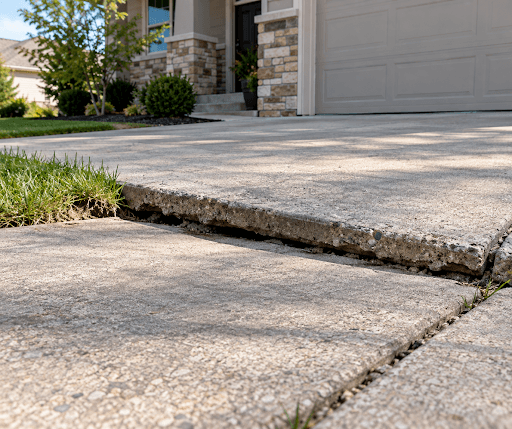
Your driveway was sinking, so you had it repaired. Maybe someone filled the low area, patched the cracks, mudjacked the slab, added soil around the edges, or even leveled the concrete. For a while, everything looked better. Then the cracks started opening again. The low spot returned. Water began collecting in the same place. Perhaps the concrete didn’t sink in exactly the same way, but it became obvious that something underneath the slab was still changing.
Recurring concrete settlement can be frustrating, particularly after you have already spent money trying to correct the problem. It is also an important clue. When concrete continues moving after a previous repair, the question is no longer simply how to level the slab. You need to understand why the support beneath the concrete continues to change.
Throughout Houston and Southeast Texas, concrete settlement can be influenced by many things. These include expansive clay soils, heavy rainfall, drainage problems, soil erosion, poorly compacted fill, underground water movement, and hidden voids. If those underlying conditions remain active, repairing what you can see at the surface may not prevent the problem from returning.
Why Can Concrete Sink Again After It Has Been Repaired?
Concrete does not support itself simply because it has been leveled. A driveway, sidewalk, patio, pool deck, garage floor, or commercial slab still depends on the material beneath it to provide consistent support.
Imagine a driveway that settles because water has been washing soil away beneath one section. Raising the concrete may correct the elevation, but if water continues moving the same way, the conditions that caused the settlement are still present. Over time, new voids can develop and the slab may begin moving again.
The same principle applies to poorly compacted fill, underground leaks, drainage problems, and changing soil conditions. A successful repair needs to consider both the position of the concrete and the condition of the material supporting it.
Surface Repairs Don’t Always Address Underground Problems
One reason concrete problems return is that the original repair may have addressed the visible symptom rather than the underlying cause. Patching a crack is a good example. Cracks can be repaired for appearance, water control, or maintenance purposes. However, filling a crack does not necessarily stop whatever caused the two sides of the slab to move.
If one portion of the concrete continues settling, the repaired crack may reopen or a new crack may form nearby. The same can happen when a low spot is covered, transition filled, or soil packed against a slab edge. These repairs may improve the surface temporarily, but they do not automatically restore support beneath a hidden void. When the same damage repeatedly appears, it is worth asking whether the visible concrete problem is a symptom of something below.
The Soil Beneath the Concrete May Still Be Moving
Houston’s soil conditions create an additional challenge. Much of the region contains expansive clay soils that react strongly to moisture changes. These soils can swell as they absorb water. They can also shrink during dry conditions, creating movement beneath the concrete. This can happen even when the slab itself remains structurally sound. That means the ground supporting a repaired slab is not necessarily static.
A repair performed during one set of moisture conditions may later be subjected to very different soil behavior. For instance, after months of drought or periods of intense rainfall. This does not mean concrete leveling is ineffective in expansive clay environments. It means the condition of the supporting soil matters. Understanding drainage, erosion, moisture changes, and the presence of underground voids helps determine whether leveling alone is sufficient. It also helps determine if stabilization and other corrective work should also be considered.
Heavy Rain Can Restart the Settlement Process
Southeast Texas rainfall can move tremendous amounts of water across and beneath developed properties. Driveways, roofs, parking areas, patios, and other hard surfaces prevent water from soaking evenly into the ground, so stormwater becomes concentrated into drainage pathways. If those pathways carry water alongside or underneath concrete, fine soil particles can gradually migrate away.
A repaired slab may have adequate support immediately after leveling, but continued erosion can create a new unsupported area months or years later. This is particularly important when recurring settlement appears after major storms. If a driveway, sidewalk, pool deck, or commercial slab seems to change after heavy rainfall, it should be part of the investigation rather than treating the problem solely as a concrete issue.
Poor Drainage Can Undo a Good Concrete Repair
Sometimes the concrete repair itself is not the reason settlement returns. The surrounding drainage conditions are. A downspout that discharges beside a driveway can repeatedly saturate the supporting soil. Improper grading may direct water toward a patio or sidewalk. A low area near a pool deck can concentrate runoff along the slab edge. A damaged drainage pipe beneath a commercial property may release water into the surrounding fill. If those conditions remain unchanged, the ground can continue eroding or shifting after the concrete has been repaired. The slab may eventually lose support again even if the original leveling work successfully restored its elevation.
PolyTex often emphasizes the importance of identifying water sources and drainage patterns when evaluating recurring settlement. Polyurethane can restore lost support, but controlling an active source of erosion may require drainage, plumbing, grading, or other work as well.
Hidden Voids May Extend Beyond the Original Repair Area
A void beneath concrete does not always have clearly defined edges that are visible from the surface. Soil loss can follow water pathways, disturbed fill, utility trenches, cracks, joints, and other underground routes. What appears to be one isolated low spot may actually be part of a larger area where support has been compromised.
If a previous repair addressed only the visibly settled portion of a slab, nearby unsupported areas may remain. Those sections can begin settling later, creating the impression that the original problem has returned. In reality, the movement is actually occurring beside or beyond the first repair.
This is one reason PolyTex’s broader soil stabilization and void-filling capabilities are important. The objective is not always simply to raise the lowest piece of concrete. In appropriate situations, the more important task is restoring support beneath the surrounding slab. It is also important to stabilize compromised areas before additional movement occurs.
Why Does a Repaired Concrete Crack Keep Coming Back?
A recurring crack provides useful information because cracks frequently develop where concrete is responding to movement or stress. Filling the opening may improve appearance and help limit water intrusion, but it does not necessarily eliminate the movement that created the crack.
If one side of a driveway continues settling because support is being lost underneath it, a repaired crack can reopen. In some cases, a new crack may appear close to the previous repair because the stresses have shifted to another part of the slab.
Not every recurring crack indicates a serious underground void. Concrete can crack for many reasons, including shrinkage, temperature changes, loads, and normal aging. The important question is whether the crack is stable or continuing to change. Widening cracks, vertical displacement, recurring repairs, or nearby settlement deserve more attention than a small crack that has remained unchanged for years.
What If the Concrete Was Previously Mudjacked?
Many properties have concrete that was previously leveled using mudjacking or slabjacking. Traditional mudjacking generally involves pumping a cementitious slurry beneath the slab to fill space and raise the concrete. The method has been used successfully for decades, but a previous mudjacking repair does not make a slab immune to future settlement. Added material has weight, and the soil beneath the repaired area must support both the original concrete and the material introduced during the repair. If weak soil, erosion, or water movement remains below that area, additional settlement can still occur.
Modern polyurethane injection uses a different approach. The expanding material is lightweight and can be introduced through relatively small access points to fill voids and restore support. Whether polyurethane is appropriate for a previously mudjacked slab depends on the condition of the concrete. It also depends on the existing material beneath it, the size and location of the voids, and the reason the area is continuing to move.
The important point is not that one repair method automatically fails and another automatically succeeds. It is that no leveling method can permanently overcome an underlying condition that continues removing or changing the support beneath the slab.
Could the Original Fill Have Been Poorly Compacted?
Some recurring settlement problems begin during construction. Areas around homes, commercial buildings, utilities, pools, retaining structures, and other improvements are frequently excavated and later backfilled. If that material is not compacted adequately, it can continue consolidating over time.
A concrete slab placed over poorly compacted fill may remain relatively level initially. As the underlying material becomes denser, its volume decreases and the concrete above follows it downward. Leveling the slab can correct the surface, but deeper weak material may continue consolidating afterward.This is particularly relevant near garage approaches, utility trenches, pool decks, building edges, and other areas where construction disturbed the original soil.
Understanding the history of the property can sometimes help explain why one particular section of concrete seems to settle repeatedly while surrounding areas remain relatively stable.
Underground Leaks Can Create Recurring Problems
When settlement keeps returning without an obvious surface drainage problem, underground water should also be considered. Plumbing lines, irrigation systems, sewer lines, stormwater pipes, and other infrastructure can release water into surrounding soil if they develop leaks or failed connections.
A relatively small leak can create significant soil changes over time. Water may soften supporting material or carry fine soil particles away. This can leave a void beneath the concrete. If the concrete is leveled without identifying the leak, the newly restored support can eventually be compromised again.
Unexplained wet areas, unusually high water usage, settlement during dry weather, or recurring soil washout, may justify further investigation. Polyurethane can help restore support after soil has been lost, but an active leak should be repaired as part of the overall solution.
Can Polyurethane Concrete Leveling Sink Again?
It is possible for concrete to experience future movement after any repair because the ground beneath a property can continue changing. Polyurethane itself does not stop expansive clay from responding to moisture, repair broken drainage pipes, or prevent soil from eroding in another nearby area.
What polyurethane provides is a way to fill appropriate underground voids and restore contact beneath the slab. It can also carefully lift settled concrete without introducing the same amount of additional weight associated with heavier fill materials. The poly can also be used for soil stabilization in certain conditions where restoring support is more important than the slab’s elevation.
Quality of the repair depends on more than the material being injected. Proper evaluation, understanding the cause of settlement, and determining whether the slab is actually suitable for leveling are all part of developing an effective repair strategy.
Sometimes Stabilization Matters More Than Lifting
Homeowners often call because they can see that concrete is uneven, so naturally the first question is how to lift it. From a long-term perspective, however, elevation is only part of the equation.
Consider a driveway that has dropped one inch because a void developed underneath it. Raising the driveway addresses the visible elevation difference, but restoring support beneath the slab is what allows it to transfer loads back into the ground properly. If adjacent sections also contain voids, stabilizing those areas may be just as important as lifting the visibly settled section.
This is why PolyTex approaches concrete leveling and soil stabilization as related services. Sometimes the goal is to lift. Sometimes the goal is to fill. Often the right repair involves understanding both.
When Replacement May Be the Better Answer
Recurring settlement does not mean a slab should automatically be replaced, but there are situations where continued leveling no longer makes sense. Concrete that has become severely fractured, deteriorated, structurally compromised, or repeatedly damaged may no longer be a good candidate for another lifting attempt.
Replacement can also be appropriate when the original concrete was poorly constructed or when other planned work requires removal of the slab anyway. In those situations, the supporting soil should still be evaluated and properly prepared before new concrete is placed. Otherwise, replacing the surface without addressing unstable conditions beneath it can recreate the same problem with a brand-new slab.
The decision between leveling and replacement should therefore consider two separate questions: Is the existing concrete worth preserving, and can the underlying support conditions be corrected?
How Do You Keep Concrete From Sinking Again?
There is no universal answer because recurring settlement can have several different causes. The most effective approach begins by identifying why the slab moved in the first place.
If water is eroding the soil, the water source or drainage pathway may need to be corrected. You may find a leak is present, and the leak needs to be repaired. If a hidden void remains beneath the concrete, that void may need to be filled. And if poorly compacted material is continuing to settle, stabilization may need to address more than the immediate surface. If the slab itself has deteriorated beyond reasonable repair, replacement may be the better option.
This cause-first approach is especially important in Houston and Southeast Texas because concrete exists in a challenging environment of expansive clay soils, heavy rainfall, periods of drought, and significant moisture fluctuations. The goal should not simply be to make the slab level today, but to understand what can be done to improve the support conditions beneath it.
Recurring Settlement Is a Clue, Not Just a Frustration
If your driveway, sidewalk, patio, pool deck, garage floor, or other concrete has started sinking again after a previous repair, the recurring movement is telling you something. This may indicate continuing erosion, changing soil conditions, poor drainage, an underground leak, or a void. However it does not automatically mean the previous contractor did something wrong, or that the concrete needs to be replaced. It simply means the conditions beneath the slab deserve another look.
PolyTex Concrete provides polyurethane concrete leveling, void filling, and soil stabilization throughout Houston, Conroe, The Woodlands, Galveston, Clear Lake, and surrounding Southeast Texas communities. By looking beyond the visible low spot and considering what is happening beneath the concrete, PolyTex can help property owners determine whether an existing slab can be stabilized and leveled or whether another repair approach makes more sense. If the same concrete problem keeps coming back, don’t just repair it again. Find out why it keeps happening.
Contact PolyTex Concrete for a free quote and evaluation.