
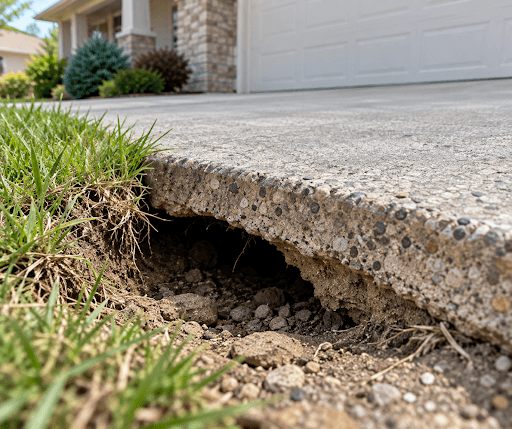
Why Is There a Gap Under My Driveway? What Houston Homeowners Need to Know About Soil Washout and Hidden Voids
Finding a gap underneath your concrete driveway can be unsettling. Soil may have washed away along one edge of the slab. Or a gap has opened where the driveway meets the street. You might also notice a hollow area near the garage. Or you may see an exposed section along the side of the driveway. Dirt and gravel may seem to wash away with every heavy Houston rain. The natural reaction is to fill the opening with dirt or gravel and move on. Before doing that, ask a more important question. Why did the soil disappear in the first place?
A visible gap beneath a driveway can point to soil erosion or settlement. It can also point to poor compaction or drainage problems. It may signal a hidden void that extends farther under the concrete than you can see. The driveway may still look normal, because concrete can temporarily bridge an unsupported area. As support disappears, the slab relies more on its own strength than the ground beneath it. Over time, that raises the risk of cracking, sinking, drainage problems, or bigger repairs. For Houston and Southeast Texas homeowners, understanding what’s happening below is the first step.
What Causes a Gap to Form Under a Concrete Driveway?
A concrete driveway depends on the soil and base materials beneath it for support. During construction, the area is graded and prepared before the concrete is placed. Soil may have been excavated, added, disturbed, or compacted to set the right elevation.
Those supporting materials do not always stay unchanged. Heavy rainfall can move soil, and poorly compacted fill can consolidate over time. Houston’s expansive clay soils can also change volume as moisture shifts. Water can enter through cracks and joints or travel alongside the driveway. It can also follow disturbed utility trenches or come from an underground leak. Often, several conditions work together to cause the problem. A section of poorly compacted fill can become vulnerable when stormwater repeatedly moves through it. The visible gap may simply be the first sign of a larger, hidden process.
Heavy Houston Rain Can Move More Soil Than You Think
Houston homeowners are certainly familiar with heavy rain, but what is harder to see is what that water may be doing underground. Stormwater follows gravity and searches for the easiest pathways through a property, including driveway edges, cracks and joints, disturbed soil, and utility trenches. As water moves through those areas, it can carry fine soil particles with it and gradually reduce the support beneath the concrete.
The process rarely creates a dramatic hole overnight. Typically, a little soil disappears in one storm, then more in the next. Over months or years, an underground pathway can widen into a real void. The concrete above hides most of this process from view. Eventually, homeowners may notice soil has receded from the slab’s edge. Or they may notice an opening has formed underneath it. By then, the visible gap may show only part of the problem.
Why Driveway Edges Are Especially Vulnerable
The edge of a driveway is a transition point between concrete and exposed soil. That transition makes it a natural path for water. If the yard slopes toward the driveway, rainwater may run right alongside the slab. Once the soil settles slightly, it creates a shallow channel for water. That channel can direct even more water along the same path in future storms.
Roof drainage can compound the problem. A downspout concentrates a large roof’s water into one small discharge area. When that discharge sits beside a driveway, repeated storms can erode the soil nearby. Over time, water may begin traveling beneath the concrete instead of beside it. At that point, a drainage issue starts affecting the support beneath the driveway itself.
Why Is There a Gap Where My Driveway Meets the Garage?
The driveway-to-garage transition deserves special attention. The driveway and garage slab are usually separate concrete placements. They may rest on different underlying soil. Soil near the house was disturbed during construction for foundation work and utilities. It was also disturbed for plumbing, grading, and backfilling. If that fill wasn’t compacted well, it may keep settling for years.
Water can enter the joint between the driveway and garage. It can also travel through the disturbed soils surrounding the home. As support changes, homeowners may notice a gap beneath the driveway. They may also see cracking near the transition or a growing step at the garage floor. The driveway may also start sloping differently in places.
These symptoms don’t automatically mean the home’s foundation is failing. A driveway, garage floor, walkway, and foundation can move differently from each other. That’s because they’re separate concrete elements with different support conditions. Figuring out which surface is actually moving is key to an accurate diagnosis.
What About a Gap Where the Driveway Meets the Street?
The far end of the driveway faces a different set of conditions. Stormwater frequently travels along curbs and gutters near the street. Driveway approaches also face vehicle loads and drainage channels. They sit at the transition between private concrete and public pavement. Soil can gradually wash away along the edges of this approach.
A homeowner may notice a hollow corner or exposed concrete near the street. They may also see a growing drop to the roadway after storms. As support is lost, vehicles keep crossing that same section of concrete. The slab must carry those loads without the ground contact it needs. A small opening at the curb may deserve more attention than it seems to. This is especially true if it keeps growing or nearby concrete is cracking.
Houston’s Expansive Clay Soils Add Another Variable
Not every driveway gap is caused by erosion. Much of the Houston region has expansive clay soils that react to moisture. These soils swell when moisture increases and shrink during dry spells. That creates movement beneath concrete even when no soil has washed away.
A driveway doesn’t expand and contract the same way the ground does. During heavy soil shrinkage, temporary gaps can form beneath parts of the slab. Repeated wet and dry cycles can also shift elevation and support over time. This is one reason a visible gap can’t be diagnosed by appearance alone. Soil erosion, clay shrinkage, consolidation, and drainage problems can all look similar at the surface. However, each requires a different response.
Could a Water Leak Create a Void Beneath the Driveway?
Underground plumbing and water lines can sometimes contribute to soil loss as well. A relatively small leak can release water into the ground without immediately becoming obvious at the surface. That water may saturate supporting soils or create an underground pathway capable of carrying fine particles away. A leak becomes more suspicious when driveway settlement or soil loss occurs during otherwise dry conditions. Unexplained wet areas, changes in water usage, recurring washout, or unusually soft soil are clues that the water may not be coming from rainfall.
Polyurethane stabilization may be able to restore support that has already been lost, but it does not repair a leaking pipe. If a plumbing or utility problem is contributing to the void, correcting that source should be part of the overall repair strategy.
The Void May Be Larger Than the Gap You Can See
One of the most important things for homeowners to understand is that the visible opening does not necessarily show the full extent of the problem. If you can see six inches beneath the edge of a driveway, it is easy to assume that the unsupported area stops somewhere close to that point. In reality, the void may extend considerably farther beneath the slab.
Concrete has enough strength to span across relatively small unsupported areas, which can make the surface misleading. The driveway may still look level even though portions of it are no longer in consistent contact with the supporting ground.
As vehicles continue traveling across the slab, those loads are transferred through concrete that may not have uniform support beneath it. Eventually, the homeowner may notice cracking, rocking, changes in elevation, or more obvious settlement. This is why visible soil loss should not be ignored simply because the driveway has not noticeably sunk yet.
Can You Just Fill the Gap With Dirt or Gravel?
Adding dirt along the edge of a driveway may improve its appearance, but it does not necessarily restore support beneath the slab. Material pushed into the opening from one side may only reach the portion of the void that is accessible from the surface. If the unsupported area extends several feet beneath the driveway, empty space can remain beyond the newly placed material.
There is also the question of why the original soil disappeared. If stormwater is actively moving through the area, replacement dirt may simply wash away during future storms. Some homeowners find themselves repeating the same cycle for years: fill the opening, wait for another heavy rain, and fill it again.
Gravel is not automatically a structural solution either. Stone can be useful in many drainage and construction applications, but pushing loose gravel beneath an existing slab does not guarantee uniform contact or adequate support. When material repeatedly disappears from the same location, it is worth investigating the underlying condition rather than continuing to replace what is being lost.
What Happens If the Gap Is Ignored?
Not every small opening beneath a driveway will develop into a major failure, but continuing soil loss can allow the unsupported area to grow. As support decreases, sections of the driveway may crack or settle, and those elevation changes can alter how water drains across the property. That can create a self-reinforcing cycle: water causes soil loss, soil loss lets the concrete settle, and the settled slab draws in more water. Water can then enter newly formed cracks or joints and continue affecting the soil below. A small opening along the driveway edge can therefore become harder to address if the underlying erosion or drainage condition stays active for years.
How Polyurethane Injection Can Restore Support
When the existing driveway is suitable for repair, polyurethane injection can fill underground voids and restore support without removing the entire slab. PolyTex Concrete uses specialized polyurethane materials that are introduced through small access points in the concrete and directed into the compromised areas below. As the polyurethane reacts and expands, it occupies available void space and helps restore contact between the slab and the supporting ground. Depending on conditions, the process can fill voids, stabilize compromised supporting materials, and carefully raise settled sections when leveling is appropriate.
Because the material is placed beneath the driveway, it can reach areas that cannot simply be packed with soil from an exposed slab edge. The goal is not merely to hide the visible gap but to restore support where it has actually been lost.
The Driveway Does Not Have to Be Sinking Yet
Concrete leveling and void filling are closely related, but they are not exactly the same service. In some situations, a driveway has already settled and the objective is to carefully return the slab closer to its intended elevation. In others, the driveway may still be reasonably level even though a known void has developed underneath it.
When the concrete has not significantly moved, restoring support may be the primary objective. Addressing an accessible void before substantial settlement or cracking can sometimes preserve repair options that become more difficult once the concrete is damaged. This distinction is especially important when homeowners discover soil loss early. A driveway that still looks good does not necessarily mean nothing needs to be done below it.
When Is Driveway Replacement the Better Choice?
Polyurethane injection is not appropriate for every driveway. Concrete that is severely deteriorated, extensively fractured, poorly constructed, or otherwise unsuitable for lifting may be better served by removal and replacement. That is why the condition of both the slab and the supporting ground matters. If the concrete remains serviceable and the main problem is lost support underneath, leveling or stabilization may allow the driveway to be preserved. If the slab has reached the end of its useful life, restoring the ground beneath badly deteriorated concrete may not make financial sense.
A good evaluation should determine what failed before deciding how to repair it. The objective is not to use polyurethane on every problem, but to choose the repair method that makes sense for the actual conditions.
Don’t Forget to Address the Source of the Water
Polyurethane can replace missing support, but it cannot redirect rain discharging beside a driveway, repair a leaking water line, or fix every drainage problem. If active water movement caused the soil loss, that source should be addressed as part of the overall solution. Depending on the property, that might involve extending a downspout, improving grading, repairing plumbing, correcting drainage, or working with another qualified contractor. The appropriate solution depends on where the water is coming from and how it is moving through the site. The strongest long-term strategy restores the support that was lost and also reduces the condition that caused it to disappear.
When Should a Driveway Gap Be Evaluated?
A small, stable opening does not automatically mean an urgent repair is required, but certain patterns deserve attention. Soil that repeatedly washes away from one spot, a growing gap, widening cracks, or new standing water can signal changing conditions beneath the slab. A driveway section that begins to sit lower than the surrounding concrete is also a warning sign.
Pay particular attention to settlement where the driveway meets the garage or street, areas that change after heavy rain, and hollow-looking slab edges. A previously repaired area that begins moving again is another reason to investigate what may be happening below the surface. Homeowners do not necessarily have to wait until a driveway becomes severely uneven before asking for an evaluation. Identifying a void before substantial settlement occurs may provide additional options for stabilizing the area while the existing concrete is still in good condition.
Before You Fill the Gap Again, Find Out Why It’s There
A gap beneath a driveway is easy to see, but the conditions that created it usually are not. Houston’s heavy rainfall, expansive clay soils, drainage patterns, disturbed construction fill, underground utilities, and recurring moisture changes can affect the material supporting residential concrete. Simply covering the visible opening does not correct any of those conditions, especially when the void extends farther beneath the slab than it appears.
PolyTex Concrete provides polyurethane concrete leveling, void filling, and soil stabilization for driveways and other residential concrete. The company serves Houston, Conroe, The Woodlands, Galveston, Clear Lake, and surrounding Southeast Texas communities.
If soil keeps disappearing beneath your driveway, or you have found a gap that seems larger than a simple landscaping issue, PolyTex can help. The team can evaluate the conditions beneath the slab and determine whether polyurethane stabilization or concrete leveling may be appropriate. Before you fill the opening again, find out why it is there by contacting PolyTex Concrete for a free quote and evaluation.