
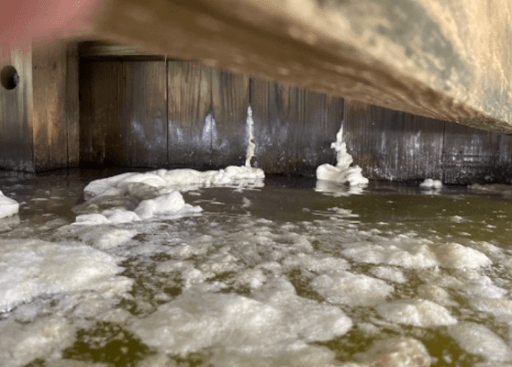
Sinking Concrete Behind Your Bulkhead? What Galveston Waterfront Property Owners Need to Know
Owning waterfront property in Galveston comes with conditions that inland property owners rarely have to consider. Water levels change, storms push tremendous volumes of water against shorelines, and heavy rainfall saturates soils from above. Drainage from the property itself also has to find its way toward the water, and your bulkhead sits directly in the middle of that environment.
When concrete behind a bulkhead begins cracking, sinking, or pulling away, it is easy to assume the concrete itself is failing. In many cases, however, the more important problem may be underneath it. Soil can gradually migrate through, beneath, or around a bulkhead system. As material disappears, underground voids can develop behind the wall and beneath patios, walkways, pool decks, driveways, parking areas, and other concrete surfaces. The concrete may continue bridging across those unsupported areas for some time before obvious settlement occurs. This matters for homeowners, marinas, commercial property owners, HOAs, and other waterfront properties throughout Galveston and the surrounding Texas Gulf Coast. Sinking concrete can therefore provide an important warning about conditions developing behind the bulkhead.
Why Does Concrete Sink Behind a Bulkhead?
Concrete requires consistent support from the soil and base material beneath it. When soil disappears, consolidates, or becomes unstable, the concrete above can begin to settle into the space that has developed below.
Behind a bulkhead, the movement of water creates additional opportunities for that support to change. Water may move through joints or penetrations in the bulkhead, beneath the wall, or around its ends. Drainage systems designed to relieve pressure behind the structure offer another path. It can also enter the soil from the land side during heavy rainfall or from plumbing and drainage systems on the property.
When moving water carries fine soil particles with it, the process can gradually remove material from behind the bulkhead. This soil migration may occur slowly enough that property owners do not immediately recognize it. By the time the concrete begins sinking, a meaningful amount of support may already have been lost.
The Concrete May Be Showing You a Soil Problem
One of the most important distinctions for waterfront property owners is the difference between concrete failure and support failure. A patio slab can be structurally sound and still sink. Meanwhile, a walkway may have relatively few cracks but begin developing a noticeable slope. A pool deck can pull away from adjacent surfaces even though the concrete itself remains in otherwise good condition.
In these situations, replacing the concrete without investigating the ground underneath it may overlook the actual cause of the movement. New concrete placed over unstable or eroding material can eventually experience the same problem. This is why PolyTex approaches waterfront concrete settlement by looking below the surface. The visible slab tells us where movement has occurred, but understanding the condition of the supporting soil helps explain why.
Galveston’s Waterfront Environment Creates Unique Challenges
Waterfront properties in Galveston experience conditions that are very different from a typical inland residential lot. The soil behind a bulkhead can be affected by tidal conditions, storm events, heavy rainfall, and drainage from the property. Wave action and changes in water pressure on opposite sides of the wall can affect it as well. During heavy rain, soil behind the bulkhead can become saturated from above. At the same time, water levels on the waterfront side may be changing. Those differences influence how water moves through and around the structure.
Galveston’s exposure to tropical storms and hurricanes adds another variable. Extreme events can rapidly change water levels and place significant hydraulic forces on waterfront structures and surrounding soils. Even when a bulkhead remains standing and appears structurally intact after a storm, soil behind it may have shifted or migrated. That is one reason waterfront property inspections should include more than simply looking at the face of the bulkhead.
Where Does the Missing Soil Go?
This is one of the first questions property owners ask when they discover a void. Soil does not simply vanish. In many cases, fine particles are transported by moving water. A small opening in a joint, penetration, drainage feature, or area beneath the bulkhead can allow water to carry material toward the waterfront. The process may begin with particles too small for a property owner to notice. As material is removed, however, the pathway can become larger and allow increasingly significant soil migration.
Water moving from the waterfront toward the property can also influence soil conditions. The direction of movement is not always the same, particularly in a coastal environment where water levels and groundwater conditions change. An underground void can result that is substantially larger than anything visible at the surface.
Why Can Concrete Look Fine While a Void Develops Underneath?
Concrete has enough structural strength to bridge across relatively small unsupported areas. That means a patio, walkway, driveway, or pool deck may continue looking normal even after soil has disappeared beneath part of the slab. Eventually, the unsupported span may become too large, or repeated loads may place enough stress on the concrete that movement begins. A crack develops, one corner drops, or the slab starts pulling away from an adjoining structure. This delay between underground soil loss and visible surface damage is important. The first obvious crack may not represent the beginning of the problem. It may instead mark the point where a problem developing below finally became visible. Known soil washout or recurring depressions behind a bulkhead therefore deserve attention even when nearby concrete has not yet noticeably settled.
What Warning Signs Should Galveston Property Owners Watch For?
Waterfront soil loss can reveal itself in several ways. You may notice depressions forming in the yard behind the bulkhead, or soil repeatedly disappearing from the same location. Other signs include gaps developing beneath concrete or areas that need to be refilled after storms.
Concrete can provide additional clues. New cracks, changing slopes, low spots, and standing water can all be signs that support conditions have changed. So can separation between adjoining slabs or a growing gap between a patio and another structure.
Pool decks deserve particular attention because waterfront pools often combine multiple systems within a relatively compact area. The pool structure, deck, plumbing, drainage, landscaping, and bulkhead may all interact with the surrounding soil. Settlement in one area should not automatically be assumed to mean the pool itself is structurally failing, but it should be investigated. The pattern matters. A small crack that remains unchanged for years tells a different story from a depression that becomes larger after every major storm.
Standing Water Can Make the Problem Worse
When concrete settles behind a bulkhead, its slope can change. A patio that once directed water away from the house or toward an appropriate drain may begin collecting water in a newly formed low area. That creates the potential for a feedback loop. Soil loss contributes to settlement, settlement changes drainage, and the altered drainage sends more water toward the affected area. Water can then enter cracks, joints, or slab edges and continue affecting the soil below. This is why a new puddle on a waterfront patio may be more than an inconvenience. If the area previously drained correctly, standing water can indicate that the concrete elevation has changed. Correcting the elevation without considering why it changed may only address part of the problem.
Does Sinking Concrete Mean the Bulkhead Is Failing?
Not necessarily. Soil loss behind a bulkhead can occur for several reasons, and the presence of a void does not automatically mean the wall itself is structurally failing. Localized soil migration may occur through joints, around penetrations, near drainage features, beneath concrete, or in areas affected by previous construction. At the same time, significant movement, leaning, or cracking should not be treated as a simple concrete leveling problem. The same is true of displacement, deteriorated structural components, or other signs of bulkhead distress. This distinction matters. Polyurethane injection and soil stabilization can address appropriate voids and lost support. They are not substitutes for structural bulkhead repair when the wall itself has failed. Complex waterfront conditions may require evaluation by an engineer, marine contractor, bulkhead specialist, or other qualified professional in addition to PolyTex.
Why Adding Dirt May Not Solve the Problem
When a depression appears behind a bulkhead, the simplest response is often to bring in more soil. That can make the surface look normal again, but it does not necessarily fill the void underneath. Loose fill placed from above may bridge across a deeper opening or fill only the upper portion of the affected area. If water continues moving through the same underground pathway, the replacement material may eventually disappear as well. Repeated filling is particularly important to notice. If a depression has been filled multiple times and keeps returning, that is evidence that the underlying condition may still be active. Instead of asking how much more dirt the area needs, it may be time to ask where the dirt keeps going.
How Polyurethane Injection Can Help Stabilize Waterfront Properties
When conditions are appropriate, polyurethane injection can provide a targeted way to fill underground voids and restore support without excavating large areas of the property. PolyTex Concrete uses specialized polyurethane materials introduced into compromised areas through carefully located injection points. As the material reacts and expands, it can fill available void space and help restore support within the affected area.
For waterfront applications, the objective may be different from a traditional driveway leveling project. Sometimes concrete has already settled and needs to be carefully raised. In other situations, the more important goal is filling voids and stabilizing compromised areas before additional settlement occurs. This ability to address support beneath the surface is what makes polyurethane particularly useful in appropriate waterfront stabilization projects.
Concrete Leveling and Soil Stabilization Work Together
Imagine a waterfront patio that has dropped because soil migrated from beneath one section. Simply raising the concrete restores the surface elevation, but the repair also needs to consider the missing support that allowed the slab to move. Polyurethane injection can help address both objectives in appropriate conditions. Material can fill void space beneath the slab while controlled expansion may allow settled concrete to be carefully lifted.
In another project, the patio may still be level even though investigation identifies a void underneath it. Here, stabilization may be more important than lifting. This is why PolyTex does not view every waterfront project as simply a concrete leveling job. Understanding what is happening in the soil behind the bulkhead is central to determining the appropriate approach.
The Source of Soil Loss Still Matters
Polyurethane can replace support that has been lost, but the cause of the soil loss should also be investigated.
A failed drainage line releasing water beneath a patio may need repair. Attention may also be needed for a bulkhead joint allowing significant soil migration. If drainage from the property is concentrating water into one area, improving the drainage pattern may be part of the solution.
In some cases, multiple contractors or professionals may need to work together. PolyTex may stabilize soil and fill voids while another contractor addresses drainage, plumbing, bulkhead components, or structural conditions.
A responsible waterfront repair should not pretend that one material solves every possible problem. The goal is to identify the conditions contributing to soil loss and address the appropriate parts of that system.
Residential Waterfront Properties Are Not the Only Concern
Similar soil migration processes can affect commercial waterfront properties throughout Galveston. Marinas, restaurants, hotels, condominium developments, and multifamily properties are common examples. Waterfront retail, storage facilities, industrial sites, and other commercial properties may also have concrete surfaces immediately adjacent to bulkheads or seawalls.
Settlement in these environments can affect pedestrian walkways, parking areas, loading zones, equipment pads, patios, service areas, and other operational surfaces. Because commercial properties may experience heavier loads and greater public use, seemingly minor settlement can become an operational or maintenance concern quickly.
Polyurethane stabilization can be particularly attractive for active commercial properties when conditions allow because targeted injection may reduce the amount of demolition and excavation required around busy waterfront areas.
Galveston Storms Make Post-Storm Inspections Especially Important
After a major coastal storm, property owners naturally inspect roofs, windows, docks, bulkheads, landscaping, and visible structures. The ground behind the bulkhead deserves attention too. Look for new depressions, areas where soil elevation has changed, fresh gaps beneath concrete, and newly developed cracks. Also watch for sections of patio or walkway that feel different underfoot and areas where water now collects unexpectedly.
Photographs can be particularly useful for waterfront properties. Taking pictures of the same locations periodically creates a simple record that can help determine whether an area is stable or continuing to change. The absence of dramatic structural damage does not necessarily mean nothing changed underground during the storm.
When Should a Waterfront Property Be Evaluated?
A small depression or isolated crack does not automatically indicate a major problem, but recurring or progressive changes deserve attention. Soil may repeatedly disappear, a depression may keep returning after being filled, or concrete may begin settling. When a void becomes visible beneath a slab, the conditions below the surface may be worth evaluating. Property owners should also pay attention when changes appear after major rain or coastal storm events. Settlement that follows a recognizable water pattern can provide valuable information about what may be happening underground. The earlier a support problem is identified, the more options may be available. Waiting until a patio, pool deck, walkway, or other slab has experienced significant cracking can limit the ability to preserve the existing concrete.
Protecting More Than the Concrete
A sinking waterfront patio is not just a concrete problem. It may be evidence that the material supporting the property is changing. That is the bigger issue.
Galveston’s waterfront environment places soil, drainage systems, concrete, and bulkheads in constant interaction with water. When soil begins migrating, the effects can eventually appear at the surface as depressions, gaps, cracking, settlement, or changing drainage patterns.
PolyTex Concrete provides polyurethane injection, void filling, concrete leveling, and soil stabilization for residential, commercial, and waterfront properties throughout Galveston and Southeast Texas.
Concrete behind your bulkhead may be beginning to sink, or soil may be disappearing from the same area again and again. Another load of dirt may not answer the most important question. Find out what is happening underneath it.
Contact PolyTex Concrete for a free quote and evaluation of your Galveston waterfront property.