
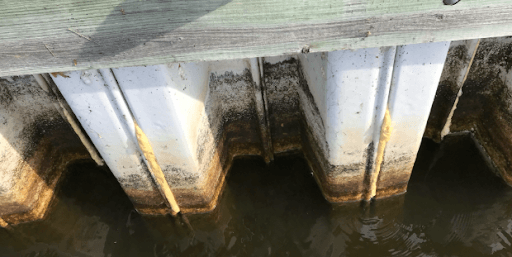
A small depression in the ground behind a bulkhead can be easy to dismiss. Maybe the landscaping seems slightly lower than it was last season. A gap develops beneath a section of concrete near the water, or you add soil to the same spot only to find that it has disappeared again after several storms. Those changes can be warning signs that soil is moving somewhere it should not be going.
Bulkheads and seawalls perform an important job on waterfront properties. They separate the retained soil on the land side from the water on the other side. When soil begins escaping through, beneath, or around that structure, underground voids can develop behind the wall. The surface may eventually sink into those spaces, creating depressions, cracked concrete, uneven walkways, or more significant areas of settlement.
For waterfront property owners throughout Galveston, Houston, Clear Lake, and surrounding Southeast Texas communities, the combination of water, storms, drainage, changing water levels, and soil conditions makes understanding these warning signs particularly important. If the ground behind your bulkhead is sinking, the question is not simply how to fill the depression. You need to understand where the soil is going and why it is moving.
Why Does Soil Disappear From Behind a Bulkhead?
A bulkhead retains soil while constantly interacting with water. Ideally, the structure and surrounding drainage system allow water pressures to be managed without allowing significant amounts of soil to migrate away. Over time, however, conditions can change. Openings may develop at joints, around penetrations, beneath portions of the structure, or in other vulnerable areas. Water moving through those openings can begin carrying fine soil particles with it.
At first, the amount of material lost may be relatively small. As the pathway develops, additional water can follow the same route and remove more soil. Eventually, an underground void forms behind the bulkhead. The surface above may continue looking normal for some time before it begins settling into the unsupported area.
Water Can Move in Both Directions
Waterfront erosion is more complicated than simple wave action against the face of a wall. Rain falling on the property has to drain somewhere. During a heavy Southeast Texas storm, water may move from the land toward the waterfront, placing additional demands on the drainage system behind the bulkhead. At other times, water conditions on the opposite side of the wall can influence soils and pressures around the structure. That means a bulkhead is dealing with water from both the property and the waterfront environment. If drainage is inadequate or soil has an easy pathway through the structure, repeated water movement can contribute to soil migration. This is why repairing the visible depression alone may not provide a lasting solution.
Heavy Rain Can Reveal a Problem That Was Already Developing
Property owners sometimes notice significant changes immediately after a major storm and understandably assume the storm created the entire problem. More often, the storm may have accelerated or exposed an existing weakness.
A small pathway behind a bulkhead can allow gradual soil migration for months or years. A period of intense rainfall may then move enough additional water through the area to remove substantially more material. Suddenly, a depression appears in the yard or a concrete walkway settles. The surface change may seem immediate, but the underground process could have been developing much longer.
Small Depressions Should Not Automatically Be Filled and Forgotten
When a low spot appears behind a bulkhead, the obvious response is to add more soil. Sometimes ordinary surface settlement is exactly what it appears to be. But if the depression returns after being filled, property owners should pay attention. The replacement material is going somewhere. It may be settling into a larger underground void, or water may be carrying it through the same pathway that removed the original soil. Continuing to add dirt from the surface can hide the symptom temporarily without restoring stable support beneath the area. Recurring depressions are a reason to investigate what is happening below ground.
Warning Signs of Soil Loss Behind a Bulkhead
Not every crack or low area indicates a major void, but several symptoms can suggest that support conditions are changing.
Watch for:
- Depressions forming behind the bulkhead
- Soil repeatedly disappearing from the same area
- New gaps along the wall
- Cracking in nearby concrete
- Sidewalk or patio settlement near the waterfront
- Open spaces beneath concrete edges
- Water flowing through unexpected locations
- Landscaping suddenly sinking
- Washout following storms
- Changes around docks or access areas
The pattern matters. A condition that continues changing deserves more attention than a surface imperfection that has remained stable for years.
Concrete Can Hide a Void Beneath It
Waterfront properties often have concrete installed immediately behind or near bulkheads. Walkways, patios, pool decks, dock approaches, and other slabs can make the property more functional, but they can also conceal what is happening underneath. If soil begins migrating away beneath a slab, the concrete may temporarily bridge across the unsupported area. The surface can remain relatively level while a void develops underneath. Eventually, the slab may crack or settle as support continues disappearing. This is why a visible gap beneath a waterfront slab or recurring settlement near the bulkhead deserves investigation even if most of the concrete still looks good.
Bulkhead Soil Loss Can Affect More Than Landscaping
The consequences of soil migration depend heavily on what is located above or near the affected area. A small void beneath an open lawn is different from a void beneath a pool deck, walkway, patio, dock access point, driveway, or other improvement.
Waterfront properties may contain significant investments close to the bulkhead, including:
- Swimming pools
- Outdoor kitchens
- Patios
- Walkways
- Boat docks
- Boat lifts
- Utilities
- Landscaping
- Fencing
- Commercial marina improvements
As soil support changes, these surrounding improvements can also be affected. Evaluating the problem early can help property owners understand the scope before more of the waterfront area becomes involved.
Does Sinking Soil Mean the Bulkhead Is Failing?
Not automatically. Soil loss behind a bulkhead is a warning sign that deserves investigation, but it does not by itself diagnose the structural condition of the wall. The soil migration could involve a localized opening, drainage issue, joint condition, or another pathway. In other situations, the problem may be related to more substantial deterioration or movement of the bulkhead. This distinction matters because PolyTex specializes in appropriate polyurethane injection, void filling, and soil stabilization applications. Structural concerns involving the bulkhead itself may require evaluation by a qualified engineer, marine contractor, or other appropriate professional. The goal should be to determine what is actually failing rather than assuming every depression requires the same repair.
Why Soil Migration Can Continue Once It Starts
Water tends to follow established pathways. Once fine particles have been removed from an area, the resulting space can make it easier for additional water to travel through the same location. That water can then carry more soil with it, gradually enlarging the pathway. This is one reason recurring washout should not be ignored.
The first small depression may represent relatively limited soil loss. If the pathway remains active through repeated storms and changing waterfront conditions, the affected area can become larger. Addressing the problem earlier may provide more stabilization options before significant surface damage occurs.
How Polyurethane Injection Can Help
For suitable applications, PolyTex can use polyurethane injection to fill underground voids and stabilize compromised soils behind or near bulkhead structures. The process allows material to be introduced into targeted underground areas without excavating the entire waterfront.
Depending on the project conditions and repair design, polyurethane injection may help:
- Fill hidden voids
- Restore support beneath concrete
- Stabilize loose or compromised soil
- Reduce soil migration through treated areas
- Reach difficult spaces behind structures
- Preserve existing concrete and landscaping
- Minimize excavation and property disruption
The injection strategy depends on the size and location of the void, surrounding soil conditions, nearby structures, and the source of the soil loss.
Bulkhead stabilization is not simply a matter of pumping material into the ground until a hole disappears. Understanding the site is essential.
Why Polyurethane Can Be Valuable on Waterfront Properties
Traditional excavation behind a bulkhead can become complicated. Landscaping, concrete, pools, patios, docks, utilities, and limited access can all make reaching an underground void disruptive.
Excavation may be necessary in some situations, particularly when structural repairs are required. However, when the bulkhead remains suitable and the primary problem involves soil loss or void formation, injection can provide a less invasive way to reach compromised areas.
Polyurethane can be placed through targeted injection locations, allowing the repair to address underground support while preserving more of the existing waterfront improvements. That can be especially valuable on finished residential properties where the surrounding backyard represents a significant investment.
Polyurethane Does Not Replace Necessary Bulkhead Repairs
Just as with culverts, this distinction is important. If the bulkhead itself has a significant structural problem, soil stabilization alone does not eliminate the need to address that condition. Filling a void behind a severely compromised wall without correcting the underlying defect could leave the source of the problem unresolved. Likewise, drainage issues on the land side may require correction.
Polyurethane injection is one tool within the repair process. Its role is to stabilize appropriate soils and fill underground spaces where support has been lost. The strongest project combines the right stabilization technique with whatever structural or drainage corrections the property actually requires.
Bulkhead Drainage Matters
Water accumulating behind a retaining structure can create pressure and contribute to soil movement. How that water is managed depends on the design and condition of the waterfront system.
Property owners should pay attention to changes in drainage after storms. If water suddenly begins collecting in new locations, emerging through unexpected areas, or carrying visible sediment, something may have changed.
PolyTex can evaluate soil stabilization and void conditions, while drainage or structural concerns outside that scope may require additional specialists. Again, the objective is not to sell one repair technique for every waterfront problem. It is to understand how water, soil, and the structure are interacting.
Residential Waterfront Properties
For homeowners, the first evidence of soil loss may appear in the backyard. A low spot develops near the water. A pool deck begins settling. A walkway cracks. Soil disappears around landscaping or beneath a slab. Because these symptoms can develop gradually, homeowners may adapt to them without realizing the area is continuing to change. Photographing suspicious areas can help. Compare the same location after several months or after major storms. Changes in elevation, gaps, cracking, or soil loss become easier to identify when there is a visual record.
Commercial Marinas and Waterfront Facilities
The same basic soil-migration process can occur at a much larger scale on commercial waterfront properties. Marinas, restaurants, multifamily properties, industrial sites, and other waterfront facilities may have extensive concrete and infrastructure immediately behind bulkheads.
Settlement can affect walkways, service areas, dock approaches, parking surfaces, utilities, and other operational areas. Commercial property managers should treat recurring soil loss as an infrastructure maintenance issue rather than simply a landscaping problem. Early evaluation can help determine whether stabilization can be performed before additional improvements are affected.
Don’t Wait for a Large Sinkhole
A dramatic collapse is not the first stage of soil loss. The earlier signs are usually much less exciting: a depression, recurring washout, a small gap, new cracking, or an area that seems slightly lower after every major storm. Those are the symptoms worth investigating.
If an underground void can be identified while the surface above remains largely intact, property owners may have more options for preserving existing concrete and improvements. Waiting until significant settlement occurs can increase the complexity of the repair.
Final Thoughts
If the ground is sinking behind your bulkhead, replacing the missing dirt may not address what is happening underground. Water may be carrying soil through, beneath, or around the waterfront structure and creating voids that extend farther than the visible depression suggests.
Heavy rainfall, drainage conditions, changing water levels, openings in the bulkhead system, and repeated soil migration can all contribute to the problem.
PolyTex Concrete provides polyurethane injection, void filling, and soil stabilization solutions for waterfront properties throughout Houston, Galveston, Clear Lake, and surrounding Southeast Texas communities. PolyTex works with homeowners, commercial property owners, marinas, contractors, engineers, and other professionals to address appropriate soil-loss conditions around bulkheads and waterfront infrastructure.
If you are seeing recurring depressions, sinking concrete, soil loss, or unexplained voids behind a bulkhead, schedule an evaluation with PolyTex Concrete. Determining where the soil is going and why it is moving is the first step toward protecting the property above it