
Can You Save Your Bulkhead? Soil Stabilization May Be The Answer
When the ground begins sinking behind a bulkhead, one of the first concerns for a waterfront property owner is whether the entire wall needs to be replaced. Along the canals, bays, and waterfront communities of Galveston and Southeast Texas, bulkhead replacement can be a significant construction project involving marine equipment, excavation, engineering, and disruption to the surrounding property.
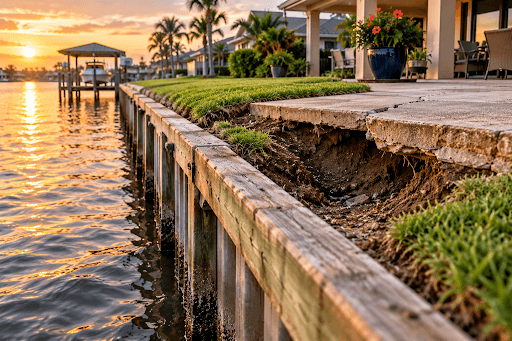
However, not every depression, void, or section of sinking concrete behind a bulkhead means the wall itself has failed. In some situations, the primary problem involves soil that has migrated away from behind an otherwise serviceable retaining structure. The bulkhead may still be performing its structural function while the ground supporting nearby patios, walkways, pool decks, and landscaping has become compromised.
Understanding the difference between structural bulkhead failure and soil loss is essential because the appropriate repairs can be very different. A deteriorated wall may require structural rehabilitation or replacement, while localized underground voids may be candidates for targeted soil stabilization once the source of erosion has been addressed. For Galveston waterfront property owners, the important question is not simply whether the bulkhead looks damaged. It is whether the wall, surrounding soil, and drainage system are functioning together as intended.
What Does a Bulkhead Actually Do?
A bulkhead is a retaining structure installed along a shoreline to hold soil in place and maintain the boundary between developed land and adjacent water. These structures are common along residential canals, commercial marinas, waterfront developments, and other shoreline properties throughout Galveston County.
Depending on the location and design, bulkheads may be constructed from vinyl, steel, concrete, timber, or combinations of materials. Some systems include anchors or tiebacks extending into the retained soil, while others rely on different structural configurations to resist earth and water pressures. The bulkhead must withstand forces from the soil behind it, changing water levels, and other environmental conditions. The surrounding drainage and backfill also influence how those forces develop.
Although the wall is the most visible component, the soil behind it is an important part of the overall waterfront system. When that material begins moving or disappearing, problems may develop even before the wall shows obvious signs of structural distress.
Why Soil Can Disappear Behind an Otherwise Intact Bulkhead
Soil migration occurs when water transports particles away from their original location. Around waterfront retaining structures, this movement may occur through defective joints, openings around penetrations, pathways beneath the wall, or other locations where water can move through the retained material.
During heavy rainfall, water entering the ground behind the bulkhead can increase groundwater pressure and move through available drainage pathways. Changes in adjacent water levels can also influence hydraulic gradients and the direction of water movement. Under certain conditions, flowing water may carry fine soil particles through openings or along pathways in the backfill. Over time, that movement can create localized voids or areas where the remaining soil has lost support.
At times a wall may continue standing while the ground behind it gradually settles. This is one reason a bulkhead can appear relatively straight and intact from the water while the property behind it develops depressions, gaps beneath concrete, or recurring low spots. However, soil settlement does not always indicate active erosion. Poorly compacted fill, natural consolidation, previous construction activity, and changing moisture conditions can produce similar symptoms.
Soil Stabilization Versus Bulkhead Replacement: Understanding the Difference
Bulkhead replacement addresses a structural retaining-wall problem. Soil stabilization addresses compromised supporting material within an appropriate area. These are related but distinct types of repair. If a bulkhead has significant structural deterioration, inadequate anchorage, severe displacement, or insufficient capacity to resist the forces acting on it, replacing or rehabilitating the wall may be necessary. If the wall remains structurally serviceable but localized soil loss has created voids behind it, the repair strategy may focus on controlling the source of soil migration and restoring the missing support. In some projects, both types of work may be required.
A structural engineer or qualified marine contractor should determine whether the bulkhead can safely remain in service. PolyTex Concrete can help evaluate appropriate polyurethane void-filling and soil stabilization applications when the surrounding support material has been compromised. The distinction matters because a stabilization contractor should not promise to save a wall that requires structural replacement.
Warning Signs That the Bulkhead Itself May Be Failing
Some visible conditions deserve particular attention because they may indicate structural concerns rather than isolated soil settlement. A bulkhead that is leaning significantly toward the water, bowing between supports, developing substantial cracks, or showing displaced panels may require professional structural evaluation.
Corroded steel components, deteriorated timber, damaged caps, failing connections, or visible movement near anchoring systems can also be concerning. Changes in the alignment of the wall may suggest that it is no longer resisting the forces acting on it as intended. These symptoms should not be treated as ordinary soil-settlement problems without further investigation.
The appropriate professional may be a coastal engineer, structural engineer, or marine contractor experienced with waterfront retaining systems. Where structural failure is suspected, the affected area may need to be restricted until the condition is assessed. Polyurethane injection cannot be assumed to restore the structural capacity of a failed bulkhead.
Warning Signs That Soil Loss May Be the Primary Concern
Other symptoms may point more directly toward changes in the material behind the wall. A depression may develop in the lawn several feet behind the bulkhead. A concrete patio may begin sinking along its waterfront edge, or a walkway may develop a gap beneath the slab. Property owners may notice that soil repeatedly disappears from the same location, even after fresh material has been added. Small openings near bulkhead joints or evidence of soil migration can also deserve attention.
Conditions such as those mentioned above, do not prove that the wall is structurally sound. They do, however, suggest that the surrounding ground should be evaluated rather than automatically assuming complete replacement is required. The key is determining whether the visible settlement reflects a localized support problem, an active erosion pathway, structural wall movement, or a combination of conditions.
Why Galveston Waterfront Properties Are Particularly Exposed
Waterfront properties in Galveston and surrounding coastal communities operate in an environment where rainfall, groundwater, tidal influences, storm surge, and changing water levels can affect soil conditions. A bulkhead may experience different water pressures on the landward and waterside faces as conditions change.
After heavy rainfall, the soil behind the wall can become saturated. If drainage is inadequate, water pressure may increase. During changes in adjacent water levels, groundwater movement through the retained soil can also change. These conditions can contribute to soil migration where susceptible materials and available pathways are present.
The degree of risk varies with the wall design, soil composition, drainage system, water conditions, and maintenance history. Not every Galveston bulkhead experiences these problems, but the coastal environment makes understanding water movement especially important when evaluating recurring settlement.
How Underground Voids Develop Behind a Bulkhead
A void begins when material is removed, displaced, or fails to adequately occupy a space within the soil mass. Behind a bulkhead, one possible mechanism involves fine soil particles moving through an opening under the influence of flowing water. As material migrates, a small space may develop within the backfill. Nearby soil can then move into that opening, allowing settlement to progress toward the surface. Over time, a depression may appear in the yard or beneath a concrete improvement.
The surface opening may be smaller than the affected underground area, particularly where a slab or compacted layer temporarily bridges across the void. However, the size and geometry of a void cannot be reliably determined from the surface depression alone. The appropriate investigation depends on the severity of settlement, accessibility, condition of the bulkhead, and surrounding site conditions.
Why Adding More Dirt May Not Solve the Problem
When soil begins disappearing behind a bulkhead, adding fill material can seem like a straightforward solution. For ordinary landscaping settlement or minor grading adjustments, additional soil may be appropriate. But when an active erosion pathway is removing material, repeatedly adding dirt may only address the visible symptom.
The new fill may follow the same pathway as the material that disappeared before it. Loose soil placed from the surface may also fail to reach deeper voids or become adequately compacted around existing structures. This can leave unsupported areas beneath patios, walkways, or other improvements even when the ground looks level again.
If the same depression returns after multiple repairs, the recurring pattern is a reason to investigate where the material is going and whether the bulkhead or drainage system has a defect.
Can Polyurethane Injection Fill Voids Behind a Bulkhead?
In appropriate conditions, polyurethane injection can be used to fill underground voids and help restore support within compromised soil or backfill zones. PolyTex Concrete uses specialized polyurethane materials that react and expand after placement. When properly selected and controlled, the material can occupy available void space and provide support in areas where soil has been lost.
For waterfront properties, a project might involve localized void filling behind an otherwise serviceable bulkhead, support restoration beneath a settled concrete walkway, or stabilization of a compromised area near a patio. The objective is not necessarily to move the wall or lift the entire property. Instead, the goal may be to restore support within a defined area while limiting excavation and disturbance.
However, the suitability of injection depends on the location and extent of the void, surrounding soil conditions, hydraulic environment, bulkhead design, and accessibility. Polyurethane injection should not be used without considering whether material could migrate through openings into adjacent water or affect the retaining structure.
Why Active Erosion Must Be Addressed
Filling an underground void does not automatically eliminate the process that created it. If soil is escaping through an open bulkhead joint, a defective drainage outlet, or another uncontrolled pathway, additional material may continue migrating after stabilization. The appropriate repair strategy should therefore consider both the missing support and the mechanism responsible for its loss.
Depending on the circumstances, a marine contractor may need to repair a bulkhead component, improve erosion protection, correct drainage, or perform other structural work. An engineer may need to evaluate groundwater conditions or determine whether the existing retaining system remains adequate.
PolyTex’s stabilization work can complement those repairs when the site conditions support the use of polyurethane. The most effective approach is one that addresses the underlying cause rather than treating the visible depression as an isolated problem.
Can Polyurethane Help Stabilize Concrete Behind a Bulkhead?
Concrete patios, pool decks, walkways, and other waterfront improvements often depend on fill material placed behind the bulkhead. If that material settles or erodes, the concrete above can lose support. A slab may begin sinking toward the shoreline, develop an uneven transition, or show a gap along its edge.
When the concrete remains suitable for repair and the underlying conditions can be appropriately addressed, polyurethane injection may help restore support and, in some situations, carefully lift the settled section. This can reduce the need to demolish otherwise serviceable concrete.
However, a patio that is extensively fractured or structurally deteriorated may require replacement. Similarly, if the bulkhead itself is moving, the structural problem must be evaluated before attempting to level adjacent concrete. The goal is to repair the appropriate component of the waterfront system in the proper sequence.
Why Pool Deck Settlement Near a Bulkhead Requires Extra Attention
Waterfront properties with swimming pools introduce additional considerations because several structures may be located close together. The pool shell, surrounding deck, plumbing, bulkhead, and supporting soil can respond differently to settlement and water movement. A sinking pool deck may be caused by compromised backfill without indicating that the pool shell or bulkhead has failed. However, changes in the deck can also occur alongside plumbing leaks, drainage problems, or structural movement. Before selecting a stabilization method, the condition of the pool and surrounding structures should be considered.
PolyTex can evaluate appropriate deck leveling and soil-support concerns, while pool specialists, marine contractors, or engineers may be needed for other components. This coordinated approach is especially important when a repair could affect multiple nearby structures.
When Bulkhead Replacement Is the Better Option
There are circumstances where replacing or structurally rehabilitating a bulkhead is the appropriate solution. Severe deterioration, significant wall displacement, failed anchoring systems, inadequate structural capacity, or extensive damage may make stabilization of the surrounding soil insufficient. A bulkhead that no longer performs its retaining function cannot be made structurally adequate simply by filling nearby voids.
Replacement may be appropriate when the existing system is near the end of its useful service life or cannot accommodate the property’s current requirements. These decisions require site-specific evaluation. The fact that polyurethane stabilization may be less disruptive in suitable applications should not influence a property owner to avoid necessary structural work. A responsible recommendation begins with the condition of the wall, not with a preferred repair product.
Can Stabilization Reduce Excavation and Property Disruption?
When the bulkhead remains serviceable and the primary problem involves accessible localized voids, targeted polyurethane injection may reduce the amount of excavation required. Traditional excavation behind a bulkhead can affect landscaping, patios, walkways, utilities, and other improvements. Depending on the site, access may be difficult and reconstruction may require significant restoration afterward.
Injection methods can sometimes reach appropriate voids through relatively small access points. The lightweight nature of polyurethane materials may also be useful where adding substantial fill weight is undesirable. However, reduced excavation is a potential benefit, not a guarantee.
Projects involving extensive erosion, structural failure, unsuitable soils, or uncontrolled water pathways may require more substantial construction methods. The appropriate choice depends on engineering requirements and actual site conditions.
What About Commercial Marinas and Waterfront Facilities?
Bulkhead soil loss is not limited to residential properties. Commercial marinas, waterfront restaurants, hotels, industrial facilities, storage properties, and other shoreline developments may experience settlement behind retaining structures. The affected area may support pedestrian walkways, parking spaces, equipment pads, utility corridors, or service routes.
Localized settlement can create operational concerns when a facility depends on those surfaces for access and daily activities. Where the bulkhead remains structurally serviceable, targeted stabilization may be worth evaluating as part of a coordinated repair plan. For commercial property owners, early identification of voids can help clarify maintenance priorities before surface deterioration becomes more extensive.
Why Engineers and Marine Contractors Can Be Important Partners
Waterfront stabilization projects often require more than one area of expertise. A marine contractor may evaluate the condition of the wall, joints, caps, and other components. A structural or coastal engineer may determine whether the retaining system remains adequate. A geotechnical professional may assess soil conditions and the extent of subsurface support loss.
PolyTex can contribute specialized polyurethane void filling and stabilization capabilities when those services are appropriate. This creates an opportunity for collaboration rather than competition between repair disciplines. For example, a marine contractor may repair a defective bulkhead component while PolyTex addresses a suitable void behind the structure. In another situation, an engineer may determine that full wall replacement is necessary and stabilization alone is not appropriate. The objective is to match each part of the problem with the professional and method best suited to address it.
What Should a Galveston Property Owner Do First?
If you notice a depression, sinking patio, recurring soil loss, or another change behind your bulkhead, begin by documenting the condition. Photographs can help establish whether the problem is progressing. Note when the movement became visible, whether it changes after heavy rainfall, and whether the area has been repaired before. Avoid placing heavy loads near suspected unsupported ground or continuing to use an area that appears unstable.
If the bulkhead shows significant leaning, displacement, cracking, or other structural concerns, arrange an evaluation by a qualified marine contractor or engineer. If the wall appears serviceable but soil loss or concrete settlement is suspected, an assessment of the surrounding support conditions can help determine whether targeted stabilization may be appropriate. Do not assume that the visible size of a depression represents the full extent of the underground condition.
Protecting Your Waterfront Property Starts With the Right Diagnosis
A sinking yard or settled patio behind a bulkhead can be concerning, especially when the property owner fears that an expensive replacement project is inevitable. But soil loss and structural bulkhead failure are not the same thing. Some waterfront properties have localized voids or compromised backfill that may be suitable for stabilization after the cause has been addressed. Others have structural deficiencies that require significant marine construction or replacement. The difference cannot be established by appearance alone.
For property owners throughout Galveston, Clear Lake, Houston, and Southeast Texas, understanding the condition of the wall and the ground behind it is the first step toward making an informed repair decision. PolyTex Concrete provides polyurethane void filling, soil stabilization, and concrete leveling for appropriate residential, commercial, and waterfront applications.
When a bulkhead remains structurally serviceable but the supporting soil or nearby concrete has been compromised, targeted polyurethane stabilization may be one component of an effective repair strategy. Before assuming your bulkhead needs replacement, find out whether the problem is the wall, the soil behind it, or both.
Contact PolyTex Concrete to discuss your waterfront soil stabilization or concrete leveling project.