
Commercial Concrete Leveling: Reducing Disruption at Active Business Properties
Commercial concrete leveling helps business owners and facility managers address sinking, uneven, or unsupported concrete without automatically committing to extensive demolition and reconstruction. Throughout Houston and Southeast Texas, commercial properties rely on stable concrete surfaces for vehicle access, equipment movement, customer traffic, deliveries, and everyday operations. When those surfaces begin settling, the resulting problems can affect far more than the appearance of the property.
A warehouse floor with an uneven transition may interfere with material-handling equipment. A retail entrance with a sinking sidewalk can create accessibility concerns, while a loading dock with settlement may complicate deliveries. Even relatively small changes in concrete elevation can become significant when employees, customers, and equipment use the affected area throughout the day.
For businesses operating on tight schedules, choosing a repair method involves balancing structural requirements, safety, cost, and operational disruption. Polyurethane injection can provide a targeted approach in suitable applications, allowing contractors to restore support beneath serviceable concrete while potentially reducing the amount of excavation and downtime required.
Why Commercial Concrete Settlement Creates Operational Problems
Commercial concrete surfaces often experience loading conditions that differ substantially from those found at residential properties. Forklifts, delivery trucks, pallet jacks, storage systems, and heavy equipment place repeated demands on floors and pavement. When the supporting soil begins settling or eroding, these loads can contribute to progressive movement and deterioration.
A small elevation difference near a loading area may create repeated impacts as equipment crosses the uneven section. Inside a warehouse, a settled floor can affect forklift travel and interfere with operations that depend on consistent floor elevations. Exterior settlement may alter drainage patterns, allowing water to collect near entrances or loading zones.
These issues can become more expensive when property managers delay evaluating the underlying cause. Surface repairs may temporarily improve conditions, but recurring settlement can continue if compromised soil support remains beneath the concrete.
How Commercial Concrete Leveling Works
Commercial concrete leveling with polyurethane injection involves introducing specialized expanding material beneath a suitable settled slab. The material reacts and expands within available void space, helping restore support and, when appropriate, carefully lifting the concrete toward its intended elevation.
The process typically begins with an evaluation of the affected surface, surrounding soil conditions, and operational requirements. Technicians identify suitable injection locations and develop a placement strategy that accounts for the slab’s thickness, condition, loading, and nearby structures. Small access holes allow the crew to introduce polyurethane beneath the concrete without automatically removing large sections of the slab.
During injection, technicians monitor the concrete’s response and adjust material placement as needed. Some projects focus primarily on filling underground voids, while others involve controlled lifting. The appropriate approach depends on whether the slab has lost support, changed elevation, or experienced both conditions.
Why Minimizing Downtime Matters for Commercial Properties
Downtime can affect a business in several ways, even when the concrete repair itself involves a relatively small area. Closing a loading dock may delay shipments, while restricting access to a warehouse aisle can interrupt inventory movement. Retail properties may need to redirect customers, and industrial facilities may have to adjust equipment schedules.
Traditional concrete replacement generally involves demolition, debris removal, base preparation, installation, and curing before the surface can return to its intended use. Depending on the project, these activities may require extended access restrictions and coordination with multiple contractors.
In suitable applications, polyurethane injection can reduce some of those disruptions because crews work through relatively small access points rather than removing the entire slab. Certain polyurethane systems develop usable strength quickly, but actual reopening times depend on the material, site conditions, loading requirements, and project specifications.
Facility managers should establish realistic operational schedules based on the approved repair plan rather than assuming every injection project allows immediate reopening.
Warehouse Floor Settlement and Material Handling
Warehouses depend on predictable floor conditions to support storage, transportation, and material-handling equipment. When a section of concrete settles, forklifts and pallet jacks may encounter uneven transitions that affect movement and equipment performance.
Settlement can also influence floor drainage and the alignment of equipment or storage systems. Facilities that use high-bay racking, automated equipment, or specialized material-handling systems may have particularly strict floor requirements.
Commercial concrete leveling may provide a repair option when the slab remains structurally suitable and the problem involves compromised support beneath the floor. However, warehouse projects require careful evaluation of loading conditions, floor tolerances, reinforcement, and any structural concerns. A qualified engineer may need to establish acceptable movement and finished elevation requirements before stabilization begins.
Loading Dock Settlement and Delivery Operations
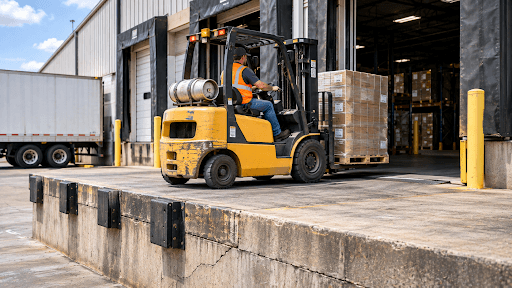
Loading docks experience concentrated traffic and repeated loading from trucks, forklifts, and material-handling equipment. Concrete settlement near dock approaches, ramps, and adjacent pavement can create uneven transitions that complicate loading operations.
A settled section may change the angle of a truck approach or create a recurring impact point for equipment crossing between surfaces. Water may also begin collecting near the dock if settlement changes the original drainage pattern.
In appropriate conditions, polyurethane injection can help restore support beneath settled concrete without requiring the entire loading area to be reconstructed. However, the repair must account for expected vehicle loads, adjacent structural components, and the condition of the existing slab.
Dock levelers, structural dock walls, and other specialized equipment may require separate evaluation. Polyurethane stabilization should address the concrete support problem without being treated as a substitute for necessary structural or mechanical repairs.
Retail Entrances and Customer Access
Retail businesses depend on safe, accessible entrances and pedestrian routes. Uneven sidewalks, settled entrance slabs, and changes in pavement elevation can create concerns for customers, employees, and delivery personnel.
A small concrete transition may become more noticeable as repeated settlement increases the difference between adjacent surfaces. In addition, sinking pavement near an entrance can redirect rainwater toward the building or create standing water.
Commercial concrete leveling may help correct certain elevation differences when the concrete remains suitable for lifting. This can provide a less disruptive alternative to replacement in appropriate situations.
However, the finished surface must satisfy applicable accessibility requirements, drainage needs, and site-specific design standards. Property managers should evaluate those requirements before selecting a repair method.
Commercial Parking Lots and Vehicle Traffic Areas
Commercial parking areas often contain large sections of concrete that experience repeated vehicle loading and exposure to rainfall. Poorly compacted fill, underground erosion, utility trenches, and changing soil moisture can contribute to settlement beneath these surfaces.
A low section may collect water after storms, while uneven pavement can create uncomfortable transitions for vehicles entering or leaving the property. Settlement near drainage structures can also indicate that surrounding soil has migrated or compressed.
Targeted polyurethane injection may help stabilize suitable concrete pavement when the underlying support problem can be addressed. However, severely deteriorated pavement or structural deficiencies may require reconstruction. The repair decision should consider traffic volume, vehicle loading, drainage, and whether the existing concrete can continue performing its intended function.
Industrial Concrete and Heavy Equipment Areas
Industrial properties may use concrete slabs to support machinery, production equipment, storage systems, and other substantial loads. Settlement in these areas can affect equipment alignment, floor elevations, and operational performance.
Unlike ordinary pedestrian surfaces, industrial slabs may require precise engineering criteria. Equipment foundations, reinforced structural slabs, and specialized production areas may respond differently to injection pressures and controlled lifting.
Polyurethane stabilization can be considered for suitable support problems, but these projects require careful coordination with engineers and facility personnel. The repair must account for equipment sensitivity, load distribution, and the potential effects of movement. Where a slab forms part of a structural foundation or supports critical equipment, the project should follow an engineered repair strategy rather than a standard leveling approach.
What Causes Commercial Concrete to Sink?
Several conditions can contribute to commercial concrete settlement throughout Houston and Southeast Texas. Poorly compacted construction fill may compress under repeated loading, while underground erosion can remove fine soil particles from beneath pavement and slabs. Heavy rainfall can introduce water into utility trenches, drainage pathways, and areas where runoff concentrates. Damaged pipes or drainage structures may also contribute to localized soil migration.
Houston’s expansive clay soils create additional challenges because certain soils shrink during dry weather and swell when moisture returns. Uneven changes in soil volume can influence the support beneath commercial concrete. These conditions may occur independently or together. A successful repair begins with understanding which process is affecting the specific area rather than assuming all settlement results from the same cause.
Why Underground Void Filling May Be Necessary
A commercial slab can remain relatively level even when supporting material has disappeared beneath it. In these situations, the concrete may temporarily bridge across a void while surrounding areas continue providing support. Repeated equipment loading can increase stress within the unsupported section. Eventually, cracking or settlement may develop, particularly if the void expands or adjacent support conditions change.
Polyurethane void filling focuses on restoring support beneath the slab without necessarily changing its elevation. This can be important in facilities where the floor must remain at a specific height or where lifting could interfere with equipment. When settlement has already occurred, the repair may involve both void filling and controlled leveling. The appropriate approach depends on the slab’s condition and the operational requirements of the property.
Planning Commercial Concrete Leveling Around Business Operations
Commercial repair projects benefit from careful scheduling and coordination. Facility managers should identify the affected area, determine how employees and equipment use it, and establish any restrictions that could influence the work. For example, a warehouse may schedule repairs during a lower-volume shift, while a retail property may prefer work outside normal customer hours. Loading dock repairs may require coordination with shipping and receiving schedules. The contractor should also consider access for equipment, nearby utilities, ventilation requirements, and any safety procedures specific to the facility. Commercial concrete leveling can sometimes reduce the duration and footprint of the repair, but the work still requires an appropriate plan for safe access and reopening.
Why Drainage Problems Must Be Addressed
Water movement contributes to many commercial concrete support problems. Roof runoff, damaged underground pipes, poorly functioning drains, and inadequate grading can allow water to enter areas beneath pavement or slabs.
If flowing water carries soil particles away, the resulting void may continue expanding until the water pathway is corrected. Filling the void without addressing active erosion can leave the original problem unresolved. For this reason, commercial stabilization projects may require coordination with drainage contractors, plumbers, or engineers. The appropriate repair sequence depends on the cause and severity of the problem.
Polyurethane injection can restore support in suitable areas, but it does not automatically repair a damaged pipe or eliminate every source of soil movement.
When Concrete Replacement Is the Better Option
Not every settled commercial slab is a candidate for polyurethane leveling. Severely deteriorated concrete, extensive structural cracking, inadequate slab thickness, or other deficiencies may make replacement necessary.
Some surfaces also require specific design characteristics that cannot be achieved through leveling alone. Industrial floors, equipment foundations, and heavily loaded pavement may need engineering review to determine whether the existing concrete remains suitable.
When replacement is necessary, correcting the supporting base before installing new concrete is important. Otherwise, unstable fill or ongoing erosion may affect the replacement slab. The objective is to select a repair that meets the property’s actual performance requirements rather than simply choosing the least disruptive method.
Working With General Contractors and Facility Managers
Commercial concrete repair often involves multiple decision-makers. Property owners may establish project budgets, facility managers coordinate access, engineers determine technical requirements, and general contractors oversee the broader scope of work. PolyTex Concrete can contribute specialized polyurethane injection, void filling, and soil stabilization services when those methods are appropriate.
For general contractors, targeted stabilization may provide an option for addressing support problems without automatically expanding the project into full concrete replacement. For facility managers, it may offer a way to coordinate repairs around operational needs. The most effective projects begin with clear communication about the slab’s condition, expected loads, repair objectives, and reopening requirements.
Commercial Concrete Leveling in Houston and Southeast Texas
Commercial properties throughout Houston, Conroe, The Woodlands, Galveston, and surrounding Southeast Texas communities encounter concrete settlement caused by changing soil conditions, construction fill, underground erosion, and everyday loading. These problems can affect warehouses, distribution centers, retail properties, industrial facilities, storage locations, parking areas, and other business environments.
PolyTex Concrete provides polyurethane concrete leveling, underground void filling, and soil stabilization for appropriate commercial applications. Our services focus on restoring support beneath serviceable concrete while recognizing when structural repairs, drainage corrections, or replacement may be necessary. For businesses that depend on reliable access and uninterrupted operations, evaluating a settlement problem early can help identify practical repair options before the damage becomes more extensive.
Keep Your Business Moving With the Right Concrete Repair
Uneven concrete can interfere with deliveries, equipment movement, customer access, and daily facility operations. Although replacement may be necessary in some situations, many support problems deserve evaluation before a business commits to extensive demolition.
Commercial concrete leveling with polyurethane injection may help restore support and correct settlement in suitable applications while reducing the amount of disruption required.
PolyTex Concrete works with commercial property owners, facility managers, general contractors, and infrastructure professionals throughout Houston and Southeast Texas.
If sinking concrete is affecting your warehouse, loading dock, parking area, retail entrance, or commercial facility, contact PolyTex Concrete for a free quote and evaluation of appropriate stabilization options.